Monday, 3 February 2020

Priya Sharma - All The Fabulous Beasts (2018)


“My wife has brine instead of blood. She’s full of the sea. I can taste it in her sweat, her tears, her sex. She’s crafty and quick. She’s lunar. She’s tidal.”

“When we wake again as human beings she says, “Of course I love, you, monster.””


Priya Sharma’s debut short story collection All The Fabulous Beasts (2018) heralds a powerful new voice in horror and dark fantasy fiction. The stories collected here are luminously beautiful with dark depths. Sharma uses folklore, mythology and monsters to help us confront truly modern anxieties around sexuality, embodiment, inheritance and guilt. Over 16 stories, Sharma demonstrates her skill at constructing powerful and disturbing visions using beautiful yet concise language, as well as drawing her readers into the minds of a varied cast of troubled and troubling characters. The end result is essential reading for anyone who loves horror, or enjoys their myths and folktales with a healthy helping of darkness.


Transformation is a key theme in Sharma’s tales, and images of the human body merged or converted into the animal recur throughout the collection. ‘Fabulous Beasts’ tells of two women who can transform into snakes; they have shed their previous identities like snakeskin so they can move on from their abusive upbringing. ‘The Nature of Bees’ sees its protagonist brought into an insectile family and groomed to be their new queen. ‘Fish Skins’ explores the relationship between a human fisherman and a mermaid, and the debt they owe each other to be able to live together. The protagonist of ‘A Son of the Sea’ undergoes a painful transformation resulting in a male birthing scene. These stories use the animal to symbolise our uncomfortable relationship with our bodies, the characters falling prey to uncontrollable desires, exploring hidden aspects of their sexuality, or finding themselves learning a new and challenging social language as their animal natures disrupt how they interact with the human and the natural.

If Sharma’s transformations straddle the line between frightening and enticing, her characters gaining something new and invigorating in exchange for their humanity, All The Fabulous Beasts contains other stories in which the body is not transformed but mutilated. In ‘The Anatomist’s Mnemonic’, the protagonist’s fetishization of hands is taken to such an extreme that when the woman of his dreams has hands that aren’t up to scratch, impromptu surgery is the only answer. The Show updates Clive Barker’s Books of Blood for the TV age, with the hosts of a fraudulent ghost hunting show wind up accidentally finding more than they bargained for. ‘Rag and Bone’ imagines a Liverpool ruled over by a vampiric elite who maintain their immortality by feeding off the bodies of the poor and disadvantaged. Other stories feature transformations gone wrong, such as the returned lover in ‘The Sunflower Seed Man’, the vengeful revenant in ‘The Rising Tide’ who the protagonist cannot stave off, or the man who has his shadow removed by a wronged servant in ‘The Absent Shade’. Others focus on extraordinary people down on their luck. The woman in ‘Small Town Stories’ can see the dead, but the murder of her mother and her best friend by her father has paralysed her in time. ‘Pearls’ shows us Medusa and Poseidon passing as human in the modern world, washed up and alienated.

A couple of the stories focus particularly on female embodiment and sexuality, and ideas around gendered assumption, pregnancy and childbirth. The protagonist in ‘Egg’ so desperately wants a child she makes a deal with a witch, while ‘The Crow Palace’ explores similar ideas but from the point of view of a changeling. Both stories offer a frank and in-depth examination of the pressure to have children and fears around infertility, as well as exploring the complexities of the parent/child relationship, especially when the child does not match the preconceived ideas about family life that the parent has. The stories compliment each other well, with the opposing viewpoints of parent and daughter allowing Sharma to subtly explore these ideas with depth and sympathy.

An undercurrent running throughout the collection is the damage wrought by Western patriarchal colonialist attitudes. We can see this in the casual disregard the rich have for the lives they feed on in ‘Rag and Bone’. This comes to the surface in several of the more powerful stories in the collection. ‘The Ballad of Boomtown’ explores how the selfishness and indulgence of investors have cursed an abandoned development town in Ireland, both on a personal and an institutional level. The au pair in ‘The Absent Shade’ is from a poor background, forced to work for a rich family where she is casually seduced by the father and loses her job because of the son’s jealousy. ‘The Englishman’ explores cross-cultural identity, and the feeling of being part of two cultures but feeling welcome in neither.

For all the fantastic nature of much of the horror of these stories, Sharma’s deft characterisation and vivid sense of place means that they always contain an element of the real and the relatable. Sharma makes good use of her settings, from Liverpool and its environs to Ireland and Wales, all vividly drawn and with a lived-in feel. The depth of her characters makes the reader engage with them, however unsympathetic, dark or disturbed they become. All The Fabulous Beasts is a powerful and engaging collection, one whose stories will haunt the reader long after they have turned the last page. I look forward to reading whatever Priya Sharma writes next.

Wednesday, 14 November 2018

Blogging The Masters

So, long time no update. I have been writing in the meantime, continuing with the reviews for Fantasy Faction, Gingernuts Of Horror and The Fantasy Hive, as well as conducting interviews, which has been wonderful and has given me the chance to speak with many of my literary heroes about their work. Unfortunately time constraints and health issues have meant that it's quietened down at the blog.

However that's not the only way my life has changed in the past couple of years. This September I went part time at the day job, so that I could study part time for a Masters in Science Fiction Literature at the University of Liverpool. I was absolutely thrilled to be accepted, coming from a science rather than a literature background, and have found the course so far to be fascinating and engaging. At the encouragement of some friends, I'm resuscitating the blog as a platform to talk about things related to the Masters as they occur to me. I'm hoping that this will help me formulate my ideas as I think about and digest these texts, and will help me map how my thinking about genre and literature evolve over the two years of the course. I'm also hoping that making the blog less of a formal thing, where I can record my ideas and impressions as they come to me, will help me to get back into the habit of doing it more frequently. I guess we'll see how it goes.

I write this in November, already halfway through the first semester, so it's not a complete record from the start. So far this year I have studied the Bodies in Space module, and the texts we have covered so far are:

Kim Stanley Robinson - Red Mars
Alastair Reynolds - House Of Suns
Nnedi Okorafor - The Book Of Phoenix
Marge Piercy - He, She And It

with the following texts to come:

Greg Egan - Diaspora
Bruce Sterling - Schismatrix

There are also additional reading texts, some of which I have found incredibly stimulating:

Naomi Mitchison - Memoirs Of A Space Woman
Sheri S. Tepper - Raising The Stones
Richard Morgan - Black Man

I'm not sure I'm likely to get around to talking about every one of these, but some of them have certainly raised things I'd like to spend time getting my head around, so we'll see what I get to. Given that I'm teaching myself a crash course in literary theory to catch up with the other students at the same time, and continuing with reviews and interviews, and working at the day job, I guess just watch this space and let's see what happens.

Thursday, 9 March 2017

Kameron Hurley - The Stars Are Legion (2017)

My review of 'The Stars Are Legion' by Kameron Hurley is up now on Fantasy Faction. This is an incredibly exciting new space opera, full of action and adventure. It also has an entirely female cast, features living generation ships and serves as a feminine reimagining of the hypermasculine hero's journey and various space opera cliches. Read more through at the link.


Kij Johnson - The Dream-Quest of Vellit Boe (2016)

My review of 'The Dream-Quest of Vellit Boe' by Kij Johnson is up next in the Tor novellas. It is an imaginative feminist reinterpretation of Lovecraft's Dreamworlds stories that works as a great piece of Weird fiction in its own right. Read more at Fantasy Faction through at the link.


Nina Allan - The Race (2014)

"If you look at a broken camcorder for long enough, its original purpose begins to seem obscure. Run your fingers over the mounded black plastic, the exposed lens, clouded now with dust, like a wide, dead eye. There's a maker's name on the handle but you've never heard of them, and it's hard to believe that an object with so little life in it ever did anything. It's an exhausted artefact, a proof of something maybe, but you don't know what of. You wonder if what you're holding in your hand has floated up from the past, or arrived here from the future or from somewhere else.
"When you look at it lying on a rubbish dump with other broken things you feel a deep sadness. Almost as if the world that ever thought to produce such a thing - your own world - has outlived its usefulness."


There are books that come along and rearrange your mental furniture. They so comprehensively inhabit the inside of your head that upon finishing them you worry that you are no longer the same person. Nina Allan's debut novel 'The Race' is one such book for me. It is a novel that challenges what science fiction is and can be. Through a series of stories that echo, reflect and interlock but never explicitly link, 'The Race' explores the themes of communication, empathy and identity. The whole thing is tied together by Allan's luminous prose. The end result is powerful, moving and profound.

'The Race' is made up of four consecutive narrative strands. In the near future in the town of Sapphire, a British seaside town made toxic by fracking, Jenna finds herself more invested in the genetically engineered smartdog races than usual when her brother Del's daughter Lumey goes missing and the only way he has of raising the money to find her is by betting his dog will win. In modern day Hastings, Christy writes stories about the town of Sapphire to process the trauma of her collapsing family. When her brother's girlfriend Linda disappears, she contacts Linda's ex Alex in the hope of discovering the truth. Alex has left Hastings and his past behind him, but is brought back to confront the ghosts of his old life by Christy. And Maree, a gifted child raised in the Croft, a government programme involved in smartdog control, must undergo a dangerous journey across the sea, where she must face the terrifying Atlantic whales before beginning her new life.

At first it might appear like the novel has two sections set in the real world, bookended by two sections set in Christy's fictional world. Jenna's concerns - her aggressive, domineering brother, her absent mother, her dying father, Lumey's lost innocence - echo Christy's, her fears and traumas transmuted into fiction so that she can process and deal with them. However 'The Race' resists such simple interpretations. Allan plays off the assumption that the section set in our real, recognisable world is the default, because of course this is all fiction, and all of the characters are built from Allan's experiences and imagination. This is highlighted by having the more fantastical sections begin and end the novel. The ontological games do not stop there, however. At first it appears as if Jenna's story exists in the recognisable future of Britain. However as more and more details are hinted at, the geography and history becomes more and more unfamiliar. By the time smartdogs are revisited in Maree's section, an entirely new geography has been introduced, as have the Atlantic whales, mysterious creatures said by some to be portals to different universes and possessing a cold alien intelligence.

This is all in aid of the novel's deft exploration of perspective and identity. Christy and Alex's sections appear to take place in our world, and overlap in a more straightforward way. Christy suspects her brother Derek of murdering Linda, and reaches out to Alex to find the truth. However Linda's fate remains ambiguous. Christy and Alex both saw different parts of Linda's story, and because of their different perspectives they come to completely different conclusions. A simple twist of perspective - Christy never seeing Linda again, but Alex bumping into her in the street - is all it takes to change a story from being sinister and frightening to an uplifting story of two people moving on with their lives. Similarly, Alex's memories of growing up in Hastings are very different from Christy's, due to his perspective as a black man growing up between his London and Nigerian heritage. A perspective shift is how Christy has created Jenna's unfamiliar world, by putting a slight twist on her familiar surroundings and life events. At the end of her story, Maree discovers she is Lumey, kidnapped from her family for the smartdog programme. Whilst at first this appears to be a resolution of the original storyline, the names and timings and geography all subtly don't match up; this is another Lumey from another Sapphire, turned kaleidoscopically through another ninety degrees.

Another main theme of the novel is communication and empathy. This is represented by the smartdogs, genetically engineered greyhounds communicated with through mental implants from their human owners. The children in the Croft are able to communicate with the dogs directly without implants. The real purpose of the government's experiments with these children is to translate alien transmissions. The natural empathic communication between the children and the dogs is contrasted with the novel's broken characters, all of whom have difficulty communicating with their families and loved ones. Christy and Jenna wind up isolated from their families, whilst Alex's relationship with Linda disintegrates due to lack of communication. All of the characters find release in their art, the one medium that allows them to communicate the emotions they are unable to process directly. This emotional overspill perhaps explains the communications across strands, the weird moments where the characters appear to make emotional contact across universes.

It is worth paying attention to the books that Allan mentions in the course of the novel. Christy becomes obsessed with 'The Chrysalids' by John Wyndham, another novel about the race of psychic posthuman children who will replace us. Similarly she mentions the Narnia books, which involve travel between different worlds. Alex and Christy bond over a love of John Cheever's short story 'The Swimmer', which hinges on a perspective change, the mind of the protagonist shaping the environment he travels through. These references act as signposts, hints to the savvy reader which give us insight into the themes and structural games Allan is playing.


I originally read 'The Race' in the NewCon Press edition. The Titan edition from 2016 adds an extra section at the end, an appendix entitled 'Brock Island'. This section follows another Maree, turned through another kaleidoscope turn, returning to Brock Island for the funeral of her friend Dodie who she traveled with on her original journey, where she discovers the work of Laura Christy, a disappeared artist who became convinced she had a twin from another universe. Once again the narrative strands link up thematically but not linearly. Maree's character arc here is the opposite of her decision at the end of her original section. However the themes of communication resurface again, with the implication that the untranslated alien transmissions are actually attempts to communicate from alternate universes. The key to the translation, and perhaps to the novel's recurring images, are provided by the sequences of an abacus in one of Christy's paintings, art achieving here what the intellect cannot.


'The Race' calls to mind some of the more ambitious explorations of the spaces between fantasy and reality, in particular 'The Affirmation' by Christopher Priest and M. John Harrison's Viriconium stories. However what is most striking about it is its originality. In its exploration of the power of art to imagine alternate selves, to reveal the shifting and changing narratives we use to give ourselves the illusion of continuous selfhood, 'The Race' tells us something profound about reality and our relationship to it. We are all inhabitants of our own individual alternate universes which may touch but never truly link up. With any luck, and with the help of great art, perhaps we can successfully communicate across them.

Monday, 6 February 2017

Nnedi Okorafor - Binti (2015)

Bringing us up to date, my review of 'Binti' by Nnedi Okorafor is up now on Fantasy Faction. The most decorated of the Tor novellas, 'Binti' is a space opera coming of age tale about the importance of empathy and communication between peoples. Read more at the link.


Nisi Shawl - Everfair (2016)

The start of this year has been slow for me, but in February I have reviewed 'Everfair', Nisi Shawl's steampunk alternate history in which the British socialist Fabian society and African American missionaries set up a Utopian society in the Belgian Congo for the victims of King Leopold II’s atrocities and escapees from the slave trade. It is a novel full of hope that nevertheless explores its characters' relationships with unflinching honesty. Read more through at the link.

Cassandra Khaw - Hammers On Bone (2016)

In December I reviewed Cassandra Khaw's 'Hammers On Bone'. This excellent addition to the Tor novella series explores the common ground between noir detective fiction and Lovecraftian horror, whilst dissecting the very real horrors of domestic abuse. It's an incredibly imaginative piece of Weird fiction in its own right, wonderfully written and full of unsettling touches. Read more through at the link.


Ken Liu - The Wall Of Storms (2016)

Next up was Ken Liu's 'The Wall Of Storms', book two in the wonderful Dandelion Dynasty series. 'The Wall Of Storms' is a worthy follow up to 'The Grace Of Kings
', which expands on the themes of the former even as it adds new characters and a greater threat. Read more through at the link.

Guy Haley - The Emperor's Railroad (2016)

Once again I have been remiss in updating the blog, I can only plead the rest of life getting in the way and apologise. So here are some posts that I have missed. First up in the Tor novella series was Guy Haley's 'The Emperor's Rairoad', an inventive mix of Dying Earth Fantasy, zombie post-apocalypse fiction and Western. Read more through at the link.


Saturday, 15 October 2016

Foz Meadows - An Accident Of Stars (2016)

My review of 'An Accident Of Stars', the wonderful new portal Fantasy by Foz Meadows and book one in her Manifold Worlds sequence, is up on Fantasy Faction. I absolutely adored this book, which manages to be both a fun, action-packed Fantasy adventure with well-written and likeable characters as well as a demonstration of the power of stories to imagine a world different from our own, to let us know that things don't have to be this way. Read more through at the link.


Emily Foster - The Drowning Eyes (2016)

Well, my ambitions to keep up with the blog have fallen by the wayside. September saw the next installment of my Tor novellas reviews up on Fantasy Faction. This time it's 'The Drowning Eyes', a compelling maritime adventure story with a diverse cast of pirates, mercenaries, and witches and wizards who control the weather. Read more through at the link.


Thursday, 25 August 2016

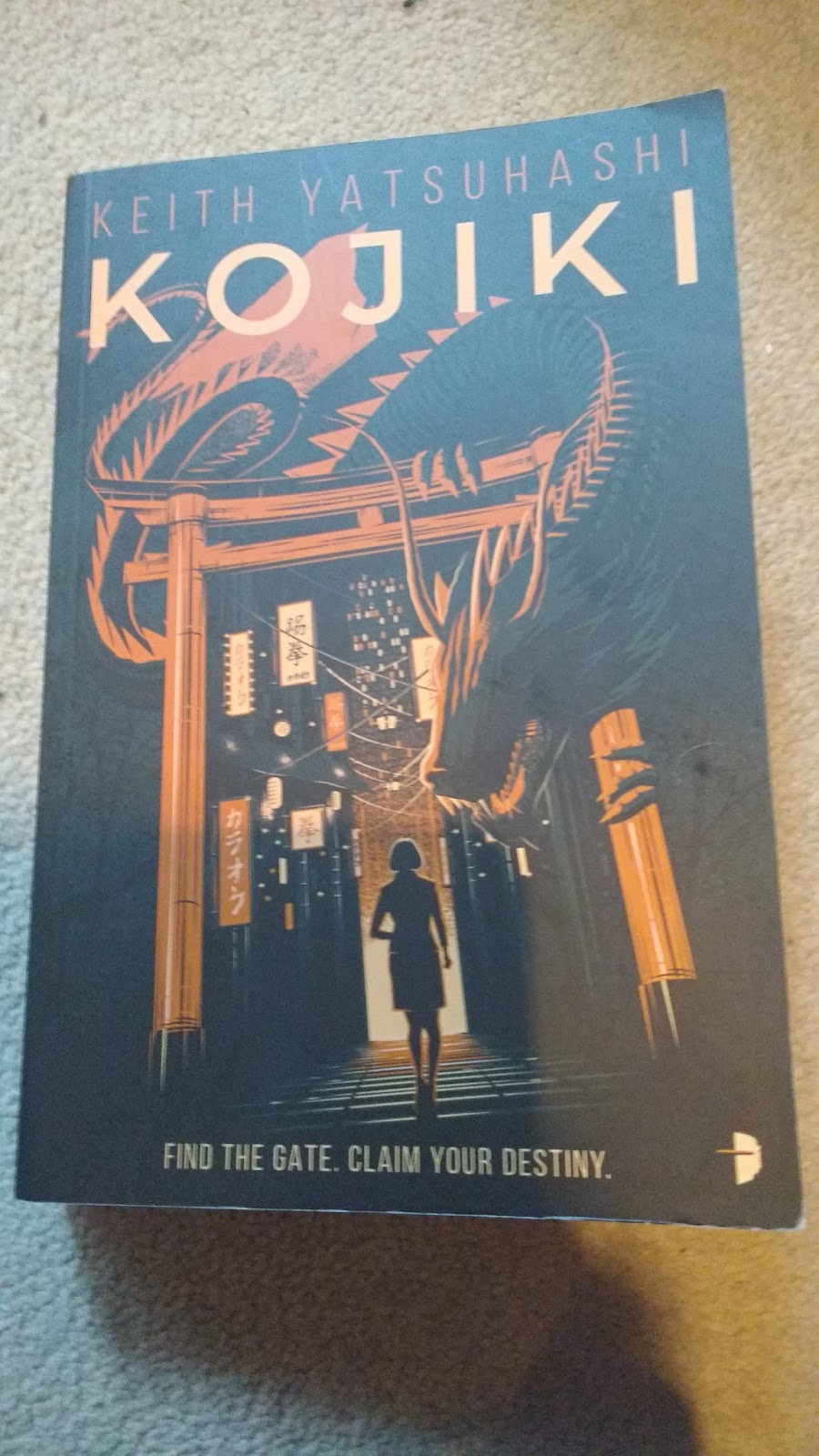
Keith Yatsuhashi - Kojiki (2016)

My review of 'Kojiki' by Keith Yatsuhashi is up on Fantasy Faction today. It's an enjoyable Fantasy epic that draws as much from Japanese mythology and pop culture as it does from Tolkien. Read more through at the link.


Thursday, 18 August 2016

Tor Novellas: Mary Robinette Kowal - Forest Of Memory (2016)

Today my review of Mary Robinette Kowal's 'Forest Of Memory', another Tor novella, is up at Fantasy Faction. The novella looks at how our relationship with technology is supplanting our relationship with nature, and has many pertinent things to say about the fetishisation of nostalgia and our dependence on digital technology. Read more through at the link.

Wednesday, 17 August 2016

Indra Das - The Devourers (2016)

My first ever solo review for Ginger Nuts Of Horror is up on the website today. I'm reviewing Indra Das' intense and striking werewolf novel, 'The Devourers'. Drawing heavily from Hindu mythology and flitting between modern day and seventeenth century India, 'The Devourers' is richly imagined and steeped in India's history. Its exploration of liminal states, transitions, and deaths and rebirths is striking and powerful, and it subverts expectations about gender and sexuality. However what really stays with the reader is Das' beautiful writing, lyrical and evocative, with an almost hallocenogenic intensity. Das is able to describe the most horrific scenes in excruciatingly graphic detail, all whilst couched in the most sumptuous prose. Read more through at the link.


Ada Palmer - Too Like The Lightning (2016)

July also saw my review of Ada Palmer's 'Too Like The Lightning' at Fantasy Faction. Palmer is a historian, and her eye for sociological detail and political intrigue runs through this fascinating and unique science fiction novel, which explores a new age of Enlightenment in the Twenty-Fifth Century. Her fascination with how people could build a better world, coupled with a realisation of how fragile a better world could be and how much could go wrong, makes this an ambigious utopia comparable to Samuel R. Delany's 'Triton' or Ursula Le Guin's 'The Left Hand Of Darkness'. However Palmer very much has her own distinctive voice. I find myself very much looking forward to the sequel. Read more through at the link.


Tor Novellas: Victor LaValle - The Ballad Of Black Tom (2016)

So, late with the updates again. Apologies all round. My review of Victor LaValle's excellent subversion of H. P. Lovecraft, 'The Ballad Of Black Tom', went up on Fantasy Faction in July. Set behind the scenes of' The Horror At Red Hook', Lovecraft's most offensively racist story, 'The Ballad Of Black Tom' brilliantly dissects Lovecraft's racism whilst paying tribute to the imagination displayed in his stories. It is a timely and powerful critique of Lovecraft, whilst being a work of imaginative Weird fiction in its own right .Read more through at the link.


Urban Fantasy at Ginger Nuts of Horror

I am thrilled to announce that I will now be writing for Ginger Nuts of Horror, a fantasic website covering all manner of Horror fiction. My first article, written in collaboration with my talented co-workers at the site, is a piece on Urban Fantasy, in which we all talked about our favourite Urban Fantasy works. No surprises that my section is the one on M. John Harrison's Viriconium. Read more at the link.

Tuesday, 28 June 2016

Kat Howard - Roses And Rot (2016)

Today my review of Kat Howard's 'Roses And Rot' is up at Fantasy Faction. This is a glorious tribute to fairy tales, drawing heavily from the Child Ballads but touching on everything from Disney to Shakespeare to tell the story of two sisters who attend a prestigious arts school that has secret links to the world of Faerie. Kat Howard gets the Fae right, which is crucial in these kind of stories, and I will happily compare this book to favourites like Diana Wynne Jones' 'Fire & Hemlock' and Ellen Kushner's 'Thomas The Rhymer'. Read more through at the link.


Sarah Pinborough - The Language Of Dying (2013)

This month I have also reviewed Sarah Pinborough's novella, 'The Language Of Dying'. This is a deeply personal work about an unnamed narrator who is looking after her dying father. Beautifully written and unflinchingly observed, it is a work that defies easy categorisation, but has much that is profound, troubling and refreshingly honest to say about our mortality, and the unexpected courses our lives take. Read more through at the link.