http://fantasy-faction.com/2015/the-book-of-the-new-sun-by-gene-wolfe
I am thrilled to announce that I've written an article for Fantasy Faction, one of my favourite websites. Just had my first article published by them today, about an old favourite of mine, Gene Wolfe's The Book Of The New Sun. This will hopefully be the first in a pitched series about overlooked classics of Fantasy. It's so exciting to see a piece of my writing up on a website that's so obviously run by and for a passionate community of fans, and I'm looking forward to contributing more articles in the future.
Showing posts with label The Book Of The New Sun. Show all posts
Showing posts with label The Book Of The New Sun. Show all posts
Tuesday, 21 July 2015

Saturday, 30 November 2013
Gene Wolfe – Peace (1975)
“...that is to say, in all of this, I think, I believe in
some sense much akin to the belief of faith, that I noticed, felt, or underwent
what I describe – but it may be that the only reason childhood memories act on
us so strongly is that, being the most remote we possess, they are the worst
remembered and so offer the least resistance to that process by which we mold
them nearer and nearer to an ideal which is fundamentally artistic, or at least
nonfactual; so it may be that some of these events I describe never occurred at
all, but only should have, and that others had not the shades and flavours –
for example, of jealousy or antiquity or shame – that I have later
unconsciously chosen to give them...”

Gene Wolfe is a notoriously slippery author, and ‘Peace’ may
just be his most slippery work. In SF and Fantasy we are so used to the
unquestionable authoritative voice, whether the competent, level headed first
person or the infallible omniscient narrator. Gene Wolfe’s work works
completely differently. His narrators, like Severian in The Book Of The New
Sun, or Alden Dennis Weer in ‘Peace’, often explicitly announce their own
unreliability fairly early on in the text, leaving the reader to puzzle out
from inferences what actually is going on. But whereas in The Book Of The New
Sun, for all its ambiguities, features lots of plot and action, ‘Peace’ is a
much more unconventional work which is much less tied to SF and Fantasy
traditions and tropes.
‘Peace’ takes the
form of the memoirs of Alden Dennis Weer’s early years, growing up as a child
in a sleepy Midwestern town and eventually becoming the wealthy president of an
orange juice production plant. Weer’s narrative voice reveals him to be affable
and talkative, with a tendency to talk around big events and an almost Ronny
Corbit-esque talent for going off on diversions. ‘Peace’ features many nested
stories, as Weer recounts tales told to him as a child, and one of the themes
of the book is why we tell stories, and in particular why Weer himself tells,
but never finishes, so many of them. Stories act both as a way we make sense of
the world around us, and as a form of escapism. The stories Weer heard as a boy
shaped the man he was to become, but now that he is an embittered old man, the
unfinished stories represent both his desire for escape and his own frustrated
potential.
‘Peace’ could just
about pass as the incredibly well-written ramblings of a dying man, but this is
still Gene Wolfe we’re talking about. There is something sinister on the
margins of these pastoral reminiscences that’s actually kind of difficult to
pinpoint. Weer is quite happy to insinuate romantic relationships with a whole
host of young, attractive women, but he stops shy of saying it in black and
white. Early on in the book, Weer tells us that one of his childhood friends
died young, and it is only from details eked out later on that you discover
that the friend was killed in an accident involving Weer. Mention of the boy
disappears from the text soon after. In much the same way, characters appear,
interact with Weer until he uncovers some deep truth in them, then disappear
from the narrative until Weer casually mentions that they died some time back.
You can’t help wondering if he killed them all. This also brings out a meta
aspect of Wolfe’s text. The author exerts a god like power over the characters
in their story, in effect killing them when they are dropped by the main thread
of the narrative; being figments of the author’s imagination, without the
oxygen of the author’s attention they cease to exist.
This is accentuated
by the warping effect Weer has on the text. Does he have magical powers, or is
he delusional? Either way it shapes the story he tells us, as he believes he
can travel back to other points in his life to talk to characters who have long
since passed away. When Weer catches the bookstore owner Mr Gold forging books,
Mr Gold explains that when he forges an ancient text, reality reshapes itself
around it to accommodate it. Rumours spread, and memory is more malleable and
suggestible than we give it credit for, and so something that never existed
becomes part of history. Multiple characters observe that history is merely
biography, the selected and selective memoirs of the victors. Weer takes issue
with both of these, and it’s ironic that he speaks for objective reality when
these are the processes by which his story shapes what we perceive of his
world.
And then there is
the central ontological uncertainty of Alden Dennis Weer himself. He tells us
that he is recovering from a debilitating stroke. But the event that starts the
book is an elm tree falling over. Perhaps not full of import in and of itself,
but we hear later on that it is a local custom to plant trees on people’s
graves, the weight on their chests prevents their spirits rising. Certainly a
lot of the stories Weer relates are ghost stories, and he claims he once
attempted necromancy. There are other hints too, in the way Weer moves
listlessly from room to room in his abandoned old house, and the way his house
seems to melt into all the different places he lived and worked, the way he
keeps circling around the deaths of those he knew, his compulsion to relive his
past. And if you look carefully at the language throughout, but especially in
that opening paragraph:
“I was asleep and heard nothing, but from the number of
shattered limbs and the size of the trunk there must have been a terrible
crashing. I woke – I was sitting up in my bed before the fire – but by the time
I was awake there was nothing to hear but the dripping of the melting snow and
I was afraid I was going to have an attack, and then, fuzzily, thought that
perhaps the heart attack had wakened me, and then that I might be dead.”
It is possible that Weer is a ghost, unaware that he has
died, for his sins denied the eponymous peace.
Monday, 25 March 2013
Nicola Griffith - Ammonite (1993)
"And these places you go, the people you find, do you come to care for them? Or do you only study them, like strange shells you might find on the beach?"
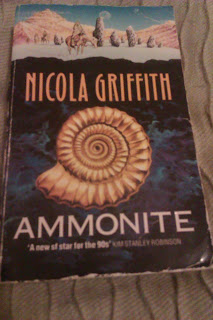
Marguerite Angelica Taishan is sent by the Company to visit Grenchstom's Plantet, or GP, pronounced Jeep, for short. The Company, being paternalistic, militaristic and colonial, had tried to take Jeep in the past, but now the planet is in quarantine because during the Company's previous attempt to colonise it a virus wiped out the entire male population. Nevertheless the completely female population is still flourishing and procreating. Marghe's job is to test a new vaccine against the virus, and to try to establish a dialogue between the Mirrors, Company's muscle, and the indigenous population. However, there is a Company warship in orbit ready to sterilise the planet if the vaccine fails, and a woman, Uaithne, from the Echraidhe tribe in the north, is spreading death and destruction through the local population.
At its heart, 'Ammonite' is about the human ability to change and adapt to our surroundings versus the drive towards stagnation and death. Marghe undergoes a physical transformation when she is infected by the virus, gaining augmented senses and abilities, but she also changes as a person as the experiences she undergoes on Jeep force her to confront her issues. Marghe starts the book as an angry young woman. She has no love of Company, having worked for them on the mining planet Beaver and suffered at their hands, and has only signed up for the job on Jeep for the unique opportunity to study its population, and she's very bitter about her mother's death and her relationship with her father. Following being captured by a violent tribe and a grueling escape across winter wastelands, she is taken in by a family of indigenous people. One of them, a woman called Thenike, is a viajera, a sort of travelling story-teller/healer. She nurses Marghe back to health, and asks Marghe the quote at the top of the page. I have to say, as someone who in their youth moved from place to place a lot, and who has difficulties making connections with people at times, I found it a deeply resonant scene. This is the catalyst for Marghe's transformation; she makes a conscious decision to stop taking the vaccine, to become a part of Jeep and its people, and to become a part of Thenike's family. It's really moving stuff, and the tone is expertly handled by Griffith.
As Marghe enters into a relationship with Thenike and starts to become a viejera herself, Company intercepts a garbled message from Marghe to Commander Danner at the Company base, and mistakenly believes that the vaccine has stopped working. Danner and the other on-planet Company personnel have to escape the base before the Company warship destroys their base, and figure out how to cooperate with the other tribes in the face of the oncoming winter and Uaithne's swathe of destruction. Marghe and Thenike return to meet the Mirrors, to help the negotiations, and Marghe winds up confronting Uaithne. The Echraidhe live by their strict traditions to help them survive the harsh winters of the north, but their numbers are dwindling. Like the stranded Mirrors and Marghe herself, they are faced with the choice of change or death. Uaithne sees herself as the Spirit of Death, and has whipped up the Echraidhe and other tribes in the north to go out in a blaze of violence. She represents the forces of stagnation and death. Marghe defeats her by using her new skills as viajera to adopt the mantle of the spirit of change, and is able to talk the tribes out of war. This provides a nice little meta-narrative, about the power of symbols and the importance of story telling, as in The Book Of The New Sun by Gene Wolfe. However Griffith wisely doesn't let our characters off the hook by short-circuiting the conflict; while disaster is averted, some people on both sides still die, and while everyone agrees to sit down and talk, the solution necessarily involves compromise and so is not perfect for everyone.
'Ammonite' is a pretty incredible book. Its concept of a world where women are the only gender is reminiscent of Whileaway from Joanna Russ' classic 'The Female Man', and in its story of a representative of another planet undergoing a journey of discovery both about themselves and the people they find themselves interacting with echoes Ursula Le Guin's 'The Left Hand Of Darkness'. However, 'Ammonite' is very much its own beast, and Griffith brings her own talents to good use here. The relationship between Marghe and Thenike is done really well; I've read a lot of SF and Fantasy where relationships are either cursorily chucked in so that the protagonist could have a love interest, or characters are forced together simply because the author wants them to be together, but here the relationship develops organically and believably. Most of the characters, however minor, are well developed, and it's a nice touch how Danner's character arc parallels Marghe's. Jeep is also positively crawling with inventive alien fauna and flora, Griffith clearly has fun inventing all sorts of bizarre plants and animals while somehow managing to stay within the range of scientific plausibility. At the end of the book there are still unresolved tensions between many of the characters, which is a more realistic and adult approach than just tying everything up with a happy ending. After all, as Marghe herself notes:
"Marge thought about her mother, of the miners on Beaver, of Danner, of Aoife; of herself. People could not be made to change. It had taken her a long time to learn that. People had to want to change themselves."

At its heart, 'Ammonite' is about the human ability to change and adapt to our surroundings versus the drive towards stagnation and death. Marghe undergoes a physical transformation when she is infected by the virus, gaining augmented senses and abilities, but she also changes as a person as the experiences she undergoes on Jeep force her to confront her issues. Marghe starts the book as an angry young woman. She has no love of Company, having worked for them on the mining planet Beaver and suffered at their hands, and has only signed up for the job on Jeep for the unique opportunity to study its population, and she's very bitter about her mother's death and her relationship with her father. Following being captured by a violent tribe and a grueling escape across winter wastelands, she is taken in by a family of indigenous people. One of them, a woman called Thenike, is a viajera, a sort of travelling story-teller/healer. She nurses Marghe back to health, and asks Marghe the quote at the top of the page. I have to say, as someone who in their youth moved from place to place a lot, and who has difficulties making connections with people at times, I found it a deeply resonant scene. This is the catalyst for Marghe's transformation; she makes a conscious decision to stop taking the vaccine, to become a part of Jeep and its people, and to become a part of Thenike's family. It's really moving stuff, and the tone is expertly handled by Griffith.
As Marghe enters into a relationship with Thenike and starts to become a viejera herself, Company intercepts a garbled message from Marghe to Commander Danner at the Company base, and mistakenly believes that the vaccine has stopped working. Danner and the other on-planet Company personnel have to escape the base before the Company warship destroys their base, and figure out how to cooperate with the other tribes in the face of the oncoming winter and Uaithne's swathe of destruction. Marghe and Thenike return to meet the Mirrors, to help the negotiations, and Marghe winds up confronting Uaithne. The Echraidhe live by their strict traditions to help them survive the harsh winters of the north, but their numbers are dwindling. Like the stranded Mirrors and Marghe herself, they are faced with the choice of change or death. Uaithne sees herself as the Spirit of Death, and has whipped up the Echraidhe and other tribes in the north to go out in a blaze of violence. She represents the forces of stagnation and death. Marghe defeats her by using her new skills as viajera to adopt the mantle of the spirit of change, and is able to talk the tribes out of war. This provides a nice little meta-narrative, about the power of symbols and the importance of story telling, as in The Book Of The New Sun by Gene Wolfe. However Griffith wisely doesn't let our characters off the hook by short-circuiting the conflict; while disaster is averted, some people on both sides still die, and while everyone agrees to sit down and talk, the solution necessarily involves compromise and so is not perfect for everyone.
'Ammonite' is a pretty incredible book. Its concept of a world where women are the only gender is reminiscent of Whileaway from Joanna Russ' classic 'The Female Man', and in its story of a representative of another planet undergoing a journey of discovery both about themselves and the people they find themselves interacting with echoes Ursula Le Guin's 'The Left Hand Of Darkness'. However, 'Ammonite' is very much its own beast, and Griffith brings her own talents to good use here. The relationship between Marghe and Thenike is done really well; I've read a lot of SF and Fantasy where relationships are either cursorily chucked in so that the protagonist could have a love interest, or characters are forced together simply because the author wants them to be together, but here the relationship develops organically and believably. Most of the characters, however minor, are well developed, and it's a nice touch how Danner's character arc parallels Marghe's. Jeep is also positively crawling with inventive alien fauna and flora, Griffith clearly has fun inventing all sorts of bizarre plants and animals while somehow managing to stay within the range of scientific plausibility. At the end of the book there are still unresolved tensions between many of the characters, which is a more realistic and adult approach than just tying everything up with a happy ending. After all, as Marghe herself notes:
"Marge thought about her mother, of the miners on Beaver, of Danner, of Aoife; of herself. People could not be made to change. It had taken her a long time to learn that. People had to want to change themselves."
Thursday, 21 February 2013
Anna Kavan - Ice (1967)
"Reality had always been something of an unknown quantity to me. At times this could be disturbing. Now, for instance. I had visited the girl and her husband before, and kept a vivid recollection of the peaceful, prosperous-looking countryside round their home. But this memory was rapidly fading, losing its reality, becoming increasingly unconvincing and indistinct, as I passed no one on the road, never came to a village, saw no lights anywhere. The sky was black, blacker untended hedges towering against it; and when the headlights occasionally showed roadside buildings, these too were always black, apparently uninhabited and more or less in ruins. It was just as if the entire district had been laid waste during my absence."

'Ice' follows three characters, who are never named. While the world begins to freeze over, the (male) narrator pursues a delicate albino girl, who is also being pursued by her husband. These three characters keep crossing paths and interacting in various ways, sometimes friendly, sometimes antagonistic. That's pretty much it for the plot. Pretty much off the bat, the narrator admits in the quote above that he's got something of a problem with reality. Like Severian in Gene Wolfe's 'Book Of The New Sun', this tips off the reader that everything we perceive here is coloured by the character relating the narrative. From the beginning the sense of encroaching doom is heavy and palpable, yet imbued with a touch of unreality. The disaster overwhelming the world, and the world itself, is presented in a detached, almost dream-like manner. This is heightened by the fact that, as the story continues, events just seem to happen without reason or context, without following the normal rules of cause and effect. Dreams, flashbacks and fantasies all intermesh without warning. The overall effect recalls Christopher Priest's masterpieces 'The Affirmation' and 'The Glamour', in that the impossibility of untangling what actually happens from the protagonist's own delusions leads to myriad possible interpretations. The protagonist's central flaw is so central to the story and their perception of events, which is why it warps the fabric of everything around it. (Appropriately enough, Priest writes the introduction to the current Peter Owen reprint of 'Ice').
Here, our protagonist's obsession with the girl overrides everything else, to the extent that it's only at the end that he realises how much of a monster he's been to her. The book serves as a fascinating and thoroughly disturbing deconstruction of the heroic male desire to save the girl; here it's presented as a co-dependent abusive relationship. The narrator frequently fantasises about the girl's helplessness and has frequent visions of her death. Whenever she shows the slightest bit of self determination he loses interest. He fetishises her victimisation. Yet he feels his life is utterly meaningless without her, and both of them are unable to escape each other. The husband is another dominating male character, strong with an undercurrent of hidden violence. The narrator sees the similarities between them, and even gets confused between his identity and that of the other man at various parts of the book, and at other points there seems to be a strong undercurrent of sexual tension between the two of them.
The book has nightmare-like ambiance, both in the vivid image of advancing towers of ice and in the way the three central characters are unable to escape from their relationship or themselves. The apocalypse here is not the aftermath of climate change, but something almost fantastical and elemental. It is similar the bizarre dream-like apocalypses in J. G. Ballard's 'The Crystal World' or 'The Drowned Word', as much reflections of inner space as doomsday scenario. The imagery the author uses to describe this shimmering wave of destruction is both beautiful and disturbing. There is something distinctly Kafkaesque about all of the characters' inbuilt sense of paranoia and persecution, and in the way this is reflected back by the people they interact with. Each place they visit is affected by the oncoming ice. While the whole book retains the feeling of a numb, dream-like hinterland, the struggle of everyday people, relegated to the background, is curiously realistic and affecting. Whether people choose to blithely ignore it and go about their daily business, party like there's no tomorrow or simply cause violence and destruction to show the world that they are still there, there's no escaping the pervading sense of doom.

Above: clearly I should photograph my books before I wreck them by reading them.
Seeing as my normal tactic for reviewing books is to compare them to other books I've read, I've possibly bitten off more than I can chew here. 'Ice' by Anna Kavan isn't much like anything else really. Anna Kavan is the pseudonym of one Helen Ferguson, who emerged from a nervous breakdown and a stint in an asylum naming herself after a character in one of her previous books and writing novels that were starkly different to pretty much everything else going. 'Ice', with its images of a ruined world and vivid sense of encroaching doom, shares some of its imagery and concerns with Post-apocalyptic SF, but with its shifting, dreamlike atmosphere and lack of any kind of explanation or rationalisation, it doesn't comfortably fit in that box. Although he doesn't mention it in the original article, 'Ice' very much fits Bruce Sterling's definition of 'slipstream' as 'an attitude of peculiar aggression against "reality"'.
'Ice' follows three characters, who are never named. While the world begins to freeze over, the (male) narrator pursues a delicate albino girl, who is also being pursued by her husband. These three characters keep crossing paths and interacting in various ways, sometimes friendly, sometimes antagonistic. That's pretty much it for the plot. Pretty much off the bat, the narrator admits in the quote above that he's got something of a problem with reality. Like Severian in Gene Wolfe's 'Book Of The New Sun', this tips off the reader that everything we perceive here is coloured by the character relating the narrative. From the beginning the sense of encroaching doom is heavy and palpable, yet imbued with a touch of unreality. The disaster overwhelming the world, and the world itself, is presented in a detached, almost dream-like manner. This is heightened by the fact that, as the story continues, events just seem to happen without reason or context, without following the normal rules of cause and effect. Dreams, flashbacks and fantasies all intermesh without warning. The overall effect recalls Christopher Priest's masterpieces 'The Affirmation' and 'The Glamour', in that the impossibility of untangling what actually happens from the protagonist's own delusions leads to myriad possible interpretations. The protagonist's central flaw is so central to the story and their perception of events, which is why it warps the fabric of everything around it. (Appropriately enough, Priest writes the introduction to the current Peter Owen reprint of 'Ice').
Here, our protagonist's obsession with the girl overrides everything else, to the extent that it's only at the end that he realises how much of a monster he's been to her. The book serves as a fascinating and thoroughly disturbing deconstruction of the heroic male desire to save the girl; here it's presented as a co-dependent abusive relationship. The narrator frequently fantasises about the girl's helplessness and has frequent visions of her death. Whenever she shows the slightest bit of self determination he loses interest. He fetishises her victimisation. Yet he feels his life is utterly meaningless without her, and both of them are unable to escape each other. The husband is another dominating male character, strong with an undercurrent of hidden violence. The narrator sees the similarities between them, and even gets confused between his identity and that of the other man at various parts of the book, and at other points there seems to be a strong undercurrent of sexual tension between the two of them.
The book has nightmare-like ambiance, both in the vivid image of advancing towers of ice and in the way the three central characters are unable to escape from their relationship or themselves. The apocalypse here is not the aftermath of climate change, but something almost fantastical and elemental. It is similar the bizarre dream-like apocalypses in J. G. Ballard's 'The Crystal World' or 'The Drowned Word', as much reflections of inner space as doomsday scenario. The imagery the author uses to describe this shimmering wave of destruction is both beautiful and disturbing. There is something distinctly Kafkaesque about all of the characters' inbuilt sense of paranoia and persecution, and in the way this is reflected back by the people they interact with. Each place they visit is affected by the oncoming ice. While the whole book retains the feeling of a numb, dream-like hinterland, the struggle of everyday people, relegated to the background, is curiously realistic and affecting. Whether people choose to blithely ignore it and go about their daily business, party like there's no tomorrow or simply cause violence and destruction to show the world that they are still there, there's no escaping the pervading sense of doom.
Wednesday, 23 January 2013
John Crowley - Engine Summer (1979)

'Engine Summer' by John Crowley is one of the most moving, lyrical and downright cruel post apocalyptic novels you will ever read. Although I try in these reviews not to give away too much of the plot, it's nearly impossible to talk about the emotional heft of 'Engine Summer' without revealing the twist at the end, so spoilers for a thirty-four year old SF novel to follow.
'Engine Summer' tells the story of Rush that Speaks, a youth on the cusp of manhood who lives in the idyllic pastoral settlement of Little Belair. Inspired by the stories of saints he hears from a wise old woman, he sets out in search of his own sainthood, and in the process suffers a series of revelations about the nature of the world he lives in and the people he shares it with.
Simple enough so far. It is a coming of age story, which is a familiar set up in post-apocalyptic SF; Russell Hoban would use a similar template for 'Riddley Walker'. 'Engine Summer' lacks the almost violent linguistic inventiveness of Hoban's masterpiece, and its spirituality is more subtle and muted, but it achieves a similar sense of pathos for its doomed protagonist and his dreams of a grander, less ruined age. The images of a youth travelling through the flotsam and jetsam of our ruined future, the significance of which has long been forgotten, also form a central part of Gene Wolfe's masterful Book Of The New Sun series. However it's hard to imagine more different protagonists than Severian and Rush that Speaks; in stark contrast to Wolfe's charming but utterly unreliable narrator who creates a tapestry of possible interpretations of every event that he relates, the people of Little Belair, and Rush that Speaks in particular, pride themselves on 'truthful speaking' - to say what you mean and mean what you say. Indeed, this facet of Rush's nature is what allows him to become the redemption to the 'angels' - the people who inhabited the Earth before the great disaster - at his own personal cost.
We find out at the end that our narrator is not Rush himself - he is a recording, whose purpose is to retell his life up until the moment of recording, which he has done over three hundred times in the past six hundred years. Through sharing Rush's formative experiences of exploration, awakening and disillusionment, the angels, and the reader of the book, are able to come to a better understanding of their own life experiences, but this version of Rush is doomed to relive these vivid and heartbreaking experiences over and over again. It is a strikingly cruel ending, and in a way a powerful metaphor for the existence of, and the way we as consumers of fiction use, fictional characters.
All of this conveys little of the wonder of Crowley's prose. He is a wonderfully lyrical writer. The style of 'Engine Summer' is less ornate and poetic than that of Crowley's influential fantasy masterpiece, 'Little, Big', but it is more naturalistic and affecting for being less mannered. It has an almost brutal concision lacking from the epic sprawl of 'Little, Big'. As wonderous as 'Little, Big' indeed is, 'Engine Summer' may well be his greatest work.
Subscribe to:
Posts (Atom)