
Showing posts with label time travel. Show all posts
Showing posts with label time travel. Show all posts
Saturday, 2 April 2016
Tim Powers - Medusa's Web (2016)
Apologies to the delay in linking to this, my internet has been unreliable. But my review of 'Medusa's Web', the new Tim Powers book, was up at Fantasy Faction last month. It sees Powers continuing his fascinations with time travel and California to tell a story that makes us reflect on our reality, and comfortably sits up there with his other books. Needless to say I loved it. Read more about it after the link.


Monday, 23 February 2015
Diana Wynne Jones - Archer's Goon (1984)
"But there was this about families, Howard thought, obediently turning to the orchestra's next piece of music. Families might hate one another, but something nevertheless made them stick together."

'Archer's Goon' is a pleasingly complex story about a family of seven power-hungry wizards who run a town, involving time travel and secret identities. It's also a farce of the first order, with Diana Wynne Jones demonstrating her keen talent for comedy. But at its heart, 'Archer's Goon' is about family, and how central our families our to who we are, for better or worse, whether we like it or not.
Howard Sykes gets home from school to find a Goon in his kitchen, demanding his father produce the two thousand words he owes Archer and refusing to leave until he gets it. As Howard and his sister investigate, they discover that their town is run by Archer and his siblings, seven wizards who want to control the world, and his father's words, which he pays each month to the mayor in lieu of council tax, may be the only thing restricting them to this town. The conspiracy is slowly revealed, with Howard meeting all of the wizards one by one, and soon the Sykes family has the attention of all the wizards, each pressing their own specific field of influence to try to coerce Howard's father into producing the two thousand words from them.
Diana Wynne Jones plays what could be terrifying and paranoia inducing as comedy.It's an approach that suits her tone, and she manages to wring an almost Terry Gilliam-esque wry humour out of the absurdities of the Sykes family's plight. Archer is in charge of power and so cuts the power to the house, which is bad enough, but Hathaway, who is in charge of transport, sends workmen to dig up their entire street, whilst Torquil, who is in charge of education and music, sends round an endless parade of street musicians to torment them. The impact of the humour is sharpened by the very real sense of threat the book sometimes crosses over into. Shine, who is in charge of crime, plans to hold Howard and his sister hostage, whilst the Goon's secret identity leads to a moment of genuine fear and doubt over his motivations. Much of the rest of the book's humour stems from its sharply observed comedy about family life. The Sykes family are all well drawn, the jokes coming from keenly-observed family interactions on Jones' behalf. In particular, Howard's little sister Anthea, nick-named Awful because of her temper tantrums, is a vehicle for much humour.
However, while all the family provide plenty of laughs, the book manages to achieve genuine emotional pathos because it takes these character's relationships seriously. Awful may be bratty and badly behaved, but she and Howard clearly care for each other deeply, and she proves on many occasions to be very shrewd and perceptive, spotting the wizards' characteristics and places in the various schemes long before the other characters. Similarly their father, for all his bumbling pomposity, and the opportunity he provides Jones to make wry jokes about authors and writer's block, has a clear sense of right and wrong and acts as a moral compass for the rest of the family. While they all have their flaws, and on more than one occasion have a flaming row with each other, Jones demonstrates that these are people who love each other and provide a complimentary network of support for each other, which is what being a family is all about.
This is reflected in Archer's family as well. Though Archer and his brothers and sisters may be scheming against each other for power, they all live in the same small area of the town, living by choice close to each other. And despite their antagonistic behaviour, Awful is quick to suss that not all of them are evil, and she finds that she can easily empathise with why they act out. While Archer, Shine and Dillian are all dangerous, Torquil, Hathaway and Erskine are eventually able to put their grudges aside to team up with Howard and his family to stop them. Their volatile personalities, and the way the family of wizards ties up with the Sykes family, mean that Howard can never fully trust that he won't have to stop them from trying to take over the world later, but they do force Howard to consider how both he and Awful are going to grow up, and what kind of people he'd like them to be.
'Archer's Goon' is a pleasingly complex story about a family of seven power-hungry wizards who run a town, involving time travel and secret identities. It's also a farce of the first order, with Diana Wynne Jones demonstrating her keen talent for comedy. But at its heart, 'Archer's Goon' is about family, and how central our families our to who we are, for better or worse, whether we like it or not.
Howard Sykes gets home from school to find a Goon in his kitchen, demanding his father produce the two thousand words he owes Archer and refusing to leave until he gets it. As Howard and his sister investigate, they discover that their town is run by Archer and his siblings, seven wizards who want to control the world, and his father's words, which he pays each month to the mayor in lieu of council tax, may be the only thing restricting them to this town. The conspiracy is slowly revealed, with Howard meeting all of the wizards one by one, and soon the Sykes family has the attention of all the wizards, each pressing their own specific field of influence to try to coerce Howard's father into producing the two thousand words from them.
Diana Wynne Jones plays what could be terrifying and paranoia inducing as comedy.It's an approach that suits her tone, and she manages to wring an almost Terry Gilliam-esque wry humour out of the absurdities of the Sykes family's plight. Archer is in charge of power and so cuts the power to the house, which is bad enough, but Hathaway, who is in charge of transport, sends workmen to dig up their entire street, whilst Torquil, who is in charge of education and music, sends round an endless parade of street musicians to torment them. The impact of the humour is sharpened by the very real sense of threat the book sometimes crosses over into. Shine, who is in charge of crime, plans to hold Howard and his sister hostage, whilst the Goon's secret identity leads to a moment of genuine fear and doubt over his motivations. Much of the rest of the book's humour stems from its sharply observed comedy about family life. The Sykes family are all well drawn, the jokes coming from keenly-observed family interactions on Jones' behalf. In particular, Howard's little sister Anthea, nick-named Awful because of her temper tantrums, is a vehicle for much humour.
However, while all the family provide plenty of laughs, the book manages to achieve genuine emotional pathos because it takes these character's relationships seriously. Awful may be bratty and badly behaved, but she and Howard clearly care for each other deeply, and she proves on many occasions to be very shrewd and perceptive, spotting the wizards' characteristics and places in the various schemes long before the other characters. Similarly their father, for all his bumbling pomposity, and the opportunity he provides Jones to make wry jokes about authors and writer's block, has a clear sense of right and wrong and acts as a moral compass for the rest of the family. While they all have their flaws, and on more than one occasion have a flaming row with each other, Jones demonstrates that these are people who love each other and provide a complimentary network of support for each other, which is what being a family is all about.
This is reflected in Archer's family as well. Though Archer and his brothers and sisters may be scheming against each other for power, they all live in the same small area of the town, living by choice close to each other. And despite their antagonistic behaviour, Awful is quick to suss that not all of them are evil, and she finds that she can easily empathise with why they act out. While Archer, Shine and Dillian are all dangerous, Torquil, Hathaway and Erskine are eventually able to put their grudges aside to team up with Howard and his family to stop them. Their volatile personalities, and the way the family of wizards ties up with the Sykes family, mean that Howard can never fully trust that he won't have to stop them from trying to take over the world later, but they do force Howard to consider how both he and Awful are going to grow up, and what kind of people he'd like them to be.
Thursday, 21 November 2013
Pat Murphy - The Falling Woman (1986)
"Do not look for revelations in the ancient ruins. You will find only what you bring: bits of memory, wisps of the past as thin as clouds in the summer, fragments of stone that are carved with symbols that sometimes make sense."

After however many reviews of effusive praise, here's a book I have mixed feelings about. This isn't going to be a hatchet job like my review of 'Tau Zero'; I actually very much enjoyed 'The Falling Woman'. It's a well written and engaging book with a well researched and fully realised setting in which rounded characters act, for the most part, in a believable way. So why the reservation? Well, 'The Falling Woman' is a book by a white person about Mayans. Now, there's nothing inherently wrong with that, but whenever one encounters something like this the warning lights begin to flash somewhere in the back of one's head. White people don't have a great track record of writing non-offensive stories about Native Americans, from the reductive and patronising portrayal of them as the noble savage in Pocahontas/Dances With Wolves/Avatar to the source of mystical evil in Poltergeist. Pat Murphy is clearly someone who's done her research; I felt I learned a fair bit about archaeology and Mayan civilisation reading this book, and she takes care to portray the Mayans as individual people and not a homogeneous mass. This only makes it all the more disappointing when the only Mayan main character winds up playing the role of the villain, and her role in the story, and that of the disappearance of the Mayan civilisation, is to act as a plot device to repair the mother-daughter relationship between the two white main characters. Problematic.
Before I sink my claws in, I'd like to say a bit more about what was good about the book. 'The Falling Woman' follows archaeologist Elizabeth Butler, a woman who left her family behind to concentrate on her career, and Diane Butler, her estranged daughter, and Elizabeth's colleagues and students as they excavate a Mayan city in Yucatan. Elizabeth can see shadows of the past, which is no doubt useful for her job, but starts to become a problem when the shadow of a Mayan priest, Zuhuy-kak, begins talking back and tells her that the goddess requires a sacrifice from her. Last time the cycle of the goddess came around, Zuhuy-kak sacrificed her own daughter...
As you can imagine, writing Elizabeth Butler is quite the balancing act and something the author handles remarkably well for the most part. The simplest explanation is that Liz Butler is suffering from schizophrenia, but the book presents all her encounters with the past as natural and believable. For the most part she comes across as a prickly, fiercely independent woman who is a bit too wrapped up in her job. The book intelligently considers that what may be seen as madness in one context - for example, human sacrifice as practiced by the Maya - is seen as part of everyday life in another, and Liz is an example of this, a woman who never wanted to settle down and have a family but was coerced into it by the pressures of society, at great damage to herself. In a way, she has already sacrificed her daughter by abandoning her to be brought up by her father alone, which makes it all the more important that she doesn't sacrifice her a second time.
Diane Butler herself is another compelling character, forced to the brink by her father's death and beginning to inherit her mother's visions, afraid that she is going insane. The building of bridges between her and her distant mother, as they slowly come to understand and like each other better, is well done and genuinely quite moving.
Right, now that's done, scalpels out. 'The Falling Woman' recalls Michael Bishop's 'No Enemy But Time', which is another book about the past encroaching on the present. However 'No Enemy But Time' benefits from having a more racially diverse protagonist than the whiter than white leads in 'The Falling Woman'. 'No Enemy But Time' emphasises the similarities between ourselves and the Homo habilis that the protagonist spends time with, forms friendships and eventually a fulfilling relationship with; whilst in 'The Falling Woman' the Maya wind up being a threatening other.
For the little its worth, Zuhuy-kak initially appears as well drawn and ultimately sympathetic, and her point about her and Liz Butler being quite similar in their own way is well taken. However her reduction to cackling villainous joke by the end of the book is unwarranted and unpleasant. After the book has spent all this time trying to demystify the Mayan religion, it seems counter productive to have ghosts screaming for blood. Throughout the book, Mayans are referred to as Indians by professional archaeologists, who should know better. The curse of being a ghost is to lack your own agency, to be stuck outside looking in on the world of the living, only able to influence receptive people. The Maya as a whole are reduced to this in the book, a colourful backdrop for the story of the white protagonists to work out their issues against. So however much I enjoyed Pat Murphy's evocative writing, the book wound up leaving a bad taste in my mouth.

After however many reviews of effusive praise, here's a book I have mixed feelings about. This isn't going to be a hatchet job like my review of 'Tau Zero'; I actually very much enjoyed 'The Falling Woman'. It's a well written and engaging book with a well researched and fully realised setting in which rounded characters act, for the most part, in a believable way. So why the reservation? Well, 'The Falling Woman' is a book by a white person about Mayans. Now, there's nothing inherently wrong with that, but whenever one encounters something like this the warning lights begin to flash somewhere in the back of one's head. White people don't have a great track record of writing non-offensive stories about Native Americans, from the reductive and patronising portrayal of them as the noble savage in Pocahontas/Dances With Wolves/Avatar to the source of mystical evil in Poltergeist. Pat Murphy is clearly someone who's done her research; I felt I learned a fair bit about archaeology and Mayan civilisation reading this book, and she takes care to portray the Mayans as individual people and not a homogeneous mass. This only makes it all the more disappointing when the only Mayan main character winds up playing the role of the villain, and her role in the story, and that of the disappearance of the Mayan civilisation, is to act as a plot device to repair the mother-daughter relationship between the two white main characters. Problematic.
Before I sink my claws in, I'd like to say a bit more about what was good about the book. 'The Falling Woman' follows archaeologist Elizabeth Butler, a woman who left her family behind to concentrate on her career, and Diane Butler, her estranged daughter, and Elizabeth's colleagues and students as they excavate a Mayan city in Yucatan. Elizabeth can see shadows of the past, which is no doubt useful for her job, but starts to become a problem when the shadow of a Mayan priest, Zuhuy-kak, begins talking back and tells her that the goddess requires a sacrifice from her. Last time the cycle of the goddess came around, Zuhuy-kak sacrificed her own daughter...
As you can imagine, writing Elizabeth Butler is quite the balancing act and something the author handles remarkably well for the most part. The simplest explanation is that Liz Butler is suffering from schizophrenia, but the book presents all her encounters with the past as natural and believable. For the most part she comes across as a prickly, fiercely independent woman who is a bit too wrapped up in her job. The book intelligently considers that what may be seen as madness in one context - for example, human sacrifice as practiced by the Maya - is seen as part of everyday life in another, and Liz is an example of this, a woman who never wanted to settle down and have a family but was coerced into it by the pressures of society, at great damage to herself. In a way, she has already sacrificed her daughter by abandoning her to be brought up by her father alone, which makes it all the more important that she doesn't sacrifice her a second time.
Diane Butler herself is another compelling character, forced to the brink by her father's death and beginning to inherit her mother's visions, afraid that she is going insane. The building of bridges between her and her distant mother, as they slowly come to understand and like each other better, is well done and genuinely quite moving.
Right, now that's done, scalpels out. 'The Falling Woman' recalls Michael Bishop's 'No Enemy But Time', which is another book about the past encroaching on the present. However 'No Enemy But Time' benefits from having a more racially diverse protagonist than the whiter than white leads in 'The Falling Woman'. 'No Enemy But Time' emphasises the similarities between ourselves and the Homo habilis that the protagonist spends time with, forms friendships and eventually a fulfilling relationship with; whilst in 'The Falling Woman' the Maya wind up being a threatening other.
 |
| On reflection, the better book |
Sunday, 1 September 2013
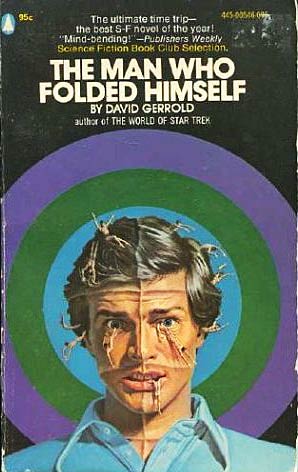
David Gerrold - The Man Who Folded Himself (1972)
"I went back and talked myself out of eliminating Jesus Christ."
Since H. G. Wells' 'The Time Machine', time travel has been an essential part of SF, but it's rarely thought through to any great extent, not even by TV shows that have time travel as part of the central conceit. Frequently little more than lip service is given to the mechanics of the process, the paradoxes that can result from it or the practical applications that it provides to those using it. I like to point to 'Bill And Ted's Excellent Adventure' as a good example of time travel used well, as not only is the time travel in that film internally consistent, the heroes, for all their apparent idiocy, realise that because they can travel through time, there's no reason why they shouldn't make life easier for themselves by coming back later and leaving useful items in convenient places. Leaving aside the blatant missed opportunities, Michael Bishop points out in 'No Enemy But Time' that the problem with travelling back in time, say, to the Pleistocene era to make out with some hot Homo habilis, (read the book, this is exactly what happens), is not just the temporal difference - the Earth, Solar System and Milky Way itself have been moving for all those millions of years, winding up in a completely different relative position. 'The Man Who Folded Himself' by David Gerrold is one of the fullest, most complete explorations of time travel and its implications the genre has ever produced.
In 'The Man Who Folded Himself', Daniel Eakins is left a belt and a document by his recently departed Uncle Jim. The document purports to be from an alternate version of himself, who received this belt in turn when his Uncle Jim died. The belt is a timebelt which allows him to travel to any set point in the past or future. Daniel proceeds to use this new found ability to cheat at the horse races to make money, see great historical events, and interact with past and future versions of himself, including having sex with both male and female versions of himself. In short, all the things you would probably do if you discovered you could travel through time.
The time travel in 'The Man Who Folded Himself' is thought out to the last detail. Daniel sensibly does some experiments to determine how it works, to find out if he can change the past or not. He likens time travel to painting, and changing the past to going back and painting over a previous mistake - the artist knows the original mistake is there but just covered up, but no one else does. Ultimately he realises that each time he travels through time he is jumping to an alternate universe. This allows him to change events in this universe without affecting his origin in a different universe - he can go back in time and kill his great grandfather, but his great grandfather still existed in the universe that spawned him. It also provides a sensible rational for why someone would invent such a potentially dangerous device - all the malcontents who would wish to rewrite time to their advantage can cheerfully go and do so in some alternate universe, preserving the original. Daniel can always go back in time and stop himself from making some change by appearing to his past self before he makes the change and talking himself out of it. This transports both versions into new variant universes, and so means he can make changes like this without the fear of erasing this variant of himself from history.
David Gerrold is probably most well known to SF fandom for writing one of the most iconic episodes of the original Star Trek, 'The Trouble With Tribbles'. After reading 'The Man Who Folded Himself', I think the most quintessentially Gerrold-ish part of the episode is where, after the fight breaks out between the crew of the Enterprise and the Klingons on Space Station K-7, Kirk interrogates his crew to find out what happened. What could be unspeakably tedious as we hear described exactly what we just witnessed instead becomes a deft piece of comedy as Kirk ekes out the truth from Scotty that the fight broke out not because the Klingons insulted Kirk but because they insulted his precious Enterprise. Gerrold here gets similar comic mileage through describing events from different perspectives, as Daniel interacts with his past and future selves, but at the same time he uses it to make serious points about the nature of perspective and the difficulty of communication between people. Even between different versions of himself, there is a gap between the intention and how it is received, as he finds different versions of himself naive or cocky.
As well as being about time travel, 'The Man Who Folded Himself' is about individual people and what it means to be one. Daniel welcomes the opportunity to interact with another version of himself because he finds the strains of interacting with other people exhausting. I think we can all relate to this on some level. When he is with another version of himself, Daniel no longer has to worry about impressing the other person whether or not they like him, if what he says or does will be misinterpreted. However as the different versions of Daniel diverge and undergo different experiences, even though they started out as the same person they become different people. In effect, it's the things we experience and the things we do that make us who we are. Change this and you change the person. In this way, 'The Man Who Folded Himself' is a tribute to the almost infinite potential within each person.
The book also explores just how complicated human sexuality is. 'The Man Who Folded Himself' was notable for its frank depiction of both homosexual and heterosexual sex, something the genre still to this day is not exactly well known for. It is not accurate to define Daniel as either purely straight or purely gay. As the different time-variants of Daniel branch out, some of them find happiness in relationships with other Daniels while some of them are ashamed by their attraction to other versions of themselves. The version of Daniel we follow through the main narrative finds sexual satisfaction both with the male Daniels and with a female time variant of himself, with whom he has a child.
This child ultimately grows up to become Daniel, while Daniel himself becomes his own Uncle Jim, leaving the timebelt to himself as his own inheritance. Thus the circle is completed, Daniel's life is like the worm Ouroboros eating its own tale, with no beginning and no end.
 |
| Not as cool as the original cover. |
In 'The Man Who Folded Himself', Daniel Eakins is left a belt and a document by his recently departed Uncle Jim. The document purports to be from an alternate version of himself, who received this belt in turn when his Uncle Jim died. The belt is a timebelt which allows him to travel to any set point in the past or future. Daniel proceeds to use this new found ability to cheat at the horse races to make money, see great historical events, and interact with past and future versions of himself, including having sex with both male and female versions of himself. In short, all the things you would probably do if you discovered you could travel through time.
 |
| Would that this belt were a timebelt! |
David Gerrold is probably most well known to SF fandom for writing one of the most iconic episodes of the original Star Trek, 'The Trouble With Tribbles'. After reading 'The Man Who Folded Himself', I think the most quintessentially Gerrold-ish part of the episode is where, after the fight breaks out between the crew of the Enterprise and the Klingons on Space Station K-7, Kirk interrogates his crew to find out what happened. What could be unspeakably tedious as we hear described exactly what we just witnessed instead becomes a deft piece of comedy as Kirk ekes out the truth from Scotty that the fight broke out not because the Klingons insulted Kirk but because they insulted his precious Enterprise. Gerrold here gets similar comic mileage through describing events from different perspectives, as Daniel interacts with his past and future selves, but at the same time he uses it to make serious points about the nature of perspective and the difficulty of communication between people. Even between different versions of himself, there is a gap between the intention and how it is received, as he finds different versions of himself naive or cocky.
As well as being about time travel, 'The Man Who Folded Himself' is about individual people and what it means to be one. Daniel welcomes the opportunity to interact with another version of himself because he finds the strains of interacting with other people exhausting. I think we can all relate to this on some level. When he is with another version of himself, Daniel no longer has to worry about impressing the other person whether or not they like him, if what he says or does will be misinterpreted. However as the different versions of Daniel diverge and undergo different experiences, even though they started out as the same person they become different people. In effect, it's the things we experience and the things we do that make us who we are. Change this and you change the person. In this way, 'The Man Who Folded Himself' is a tribute to the almost infinite potential within each person.
The book also explores just how complicated human sexuality is. 'The Man Who Folded Himself' was notable for its frank depiction of both homosexual and heterosexual sex, something the genre still to this day is not exactly well known for. It is not accurate to define Daniel as either purely straight or purely gay. As the different time-variants of Daniel branch out, some of them find happiness in relationships with other Daniels while some of them are ashamed by their attraction to other versions of themselves. The version of Daniel we follow through the main narrative finds sexual satisfaction both with the male Daniels and with a female time variant of himself, with whom he has a child.
This child ultimately grows up to become Daniel, while Daniel himself becomes his own Uncle Jim, leaving the timebelt to himself as his own inheritance. Thus the circle is completed, Daniel's life is like the worm Ouroboros eating its own tale, with no beginning and no end.
Sunday, 3 March 2013
Yasutaka Tsutsui - The Girl Who Leapt Through Time (1967)

Listen: Kazuko Yoshiyama has come unstuck in time. Kazuko is exposed to a strange chemical while cleaning up the school lab with her friends Goro and Kazuo. Which winds up being fortunate. The next day, an earthquake and a fire wind up making Kazuko and Goro late for school and in their hurry they get hit by a truck. Just before the impact, Kazuko wakes up in her bed two mornings earlier. Kazuko has to convince herself and her friends that she really did travel through time, prevent the accident from occurring and stop herself from travelling through time. Will she manage? Spoilers to follow!
Yasutaka Tsutsui is a Japanese SF author who I was initially familiar with through his short story collection 'Salmonella Men On Planet Porno'. This is an excellent collection of bizarre, sardonic and somewhat Ballardian dissections of modern culture in an SF framework. Most feature unpleasant or unreliable protagonists and a sadistic twist at the end. 'The Girl Who Leapt Through Time' could not be more different in tone. It's a sweet, nostalgic YA novella with a bittersweet ending, both breezily engaging and moving. However, bubbling underneath is just enough of a sinister undercurrent to remind you that this is Tsutsui we're dealing with.
The story's short length means that it moves along at a good pace. When faced with evidence, rather than sitting around hand-wringing, Kazuko's friends and teacher opt to believe her and help her find the solution to the problem. She manages to leap back in time to just before she encountered the chemical in the lab, where she finds out that all this was caused by Kazuo, who is actually a time traveler from the far future trying to get home. He confesses that he has developed feelings for her, but has to return to his own time. Kazuko loses the ability to time travel, Kazuo erases everyone's memories of him, and he returns to the future, promising that they will meet again some day, but that she won't remember who he is.
There's a lot to like about how this all plays out. On the surface, you have a deceptively simple story arc - two young people just realise they have feelings for each other when circumstances force them apart - which is both poignant and relatable. The mechanics of the time travel is never explained, but it all works out in an intuitive and pleasing way that doesn't leave any unstable time loops or contradictions. The story is told simply, elegantly and straightforwardly, with no narrative flab.
However, there's a little more going on here than meets the eye. Kazuo winds up being a thoroughly ambiguous and mysterious character. He provides us with the big chunk of exposition towards the end which explains what's going on, but we only have his word for it. The future he describes is subtly dystopian. Tsutsui very neatly avoids any hysteria in describing it, but there are some nice parallels with Aldous Huxley's 'Brave New World' thrown into the central conceit. Kazuo hints that a violent war is looming, and the spectres of overpopulation, poor people exiled to colonies on Mars and the Moon and computerised ice-schools all rear their ugly heads. While Kazuo suggests that things do eventually improve, again we only have his word to go on, and he admits that he prefers Kazuko's present to his future, perhaps because in this time he is able to make friends and connect with people in a way that's no longer possible in the future.
And of course, there's the whole memory wipe. Kazuo created a false identity and implanted false memories of himself into all his classmates and teachers, as well as the childless old couple who are supposed to pass as his parents. He then proceeds to erase everyone's memories of him without a qualm, to save himself from being arrested by the temporal police when he returns to his present. This is both creepy and manipulative, however believable his arguments that this will be the safest course of action for everyone may be. It is this sinister undercurrent, part of the narrative but wisely left uncommented on by the author, that gives 'The Girl Who Leapt Through Time' both shade and depth as a story.
The Alma Books translation, which I have, also appends another Tsutsui YA novella, 'The Stuff That Nightmares Are Made Of', which is a welcome addition. While it is less haunting than 'The Girl Who Leapt Through Time' and has no SF trappings, 'Nightmares' is perhaps more in the vein of the 'Salmonella Men' short stories, with its vivid, horrifying and somewhat Freudian dream imagery. Its story, about a young girl overcoming her fears, is perhaps more typical YA fare, but the reveal at the end, with its trauma-induced amnesia, is typical Tsutsui territory, albeit with a more optimistic and uplifting outcome than is typical in 'Salmonella Men'.
Subscribe to:
Posts (Atom)