Saturday, 2 November 2013

Joe Haldeman – The Forever War (1974)

“Relativity propped it up, at least gave it the illusion of being there... the way all reality becomes illusory and observer-oriented when you study general relativity. Or Buddhism. Or get drafted.”


‘The Forever War’ is at heart a war novel. Joe Haldeman had served in Vietnam and his experiences inform the book. The concept is pure hard SF worthy of Robert Heinlein or Larry Niven. Soldiers are conscripted to fight in an interstellar war. Because of relativity a few years passing for the soldiers means many decades passing back on earth, they return home to a world hopelessly alien to them that has forgotten all about them. The soldiers finding themselves lost and out of touch in a world that has drastically moved on without them is a powerful metaphor for the reception the soldiers returning home from Vietnam received in reality. The main weapon that the soldiers use to fight the hive-mind aliens is even powered armour, same as in Heinlein’s ‘Starship Troopers’. But the two books could not be further apart. ‘The Forever War’ is about the horror and futility of war, and the senseless waste of lives lost and displaced that follow.
   The protagonist is William Mandella, one of a hundred strong and healthy young people with IQs above 150 called up to fight against a terrifying unknown alien threat that has been destroying Earth spaceships. From the beginning, Mandella is cynical about the army. He studied physics and was looking to go into teaching and has no desire to be in the army or fight in a war. Unlike the protagonist of ‘Starship Troopers’, who learns that the army is always right, Mandella’s experience is one of horror, pain and grief. There is an argument that any anti-war story has the problem that it is inherently glamourising war by turning it into entertainment, no matter what the ultimate message. ‘The Forever War’ uses this to its advantage by initially appearing to be a fun, Heinlein-esque space adventure yarn, in much the same way that William Goldings’ ‘Lord Of The Flies’ initially appears to be a Ballentyne-esque boys’ adventure before things start to go wrong. Mandella, with his high IQ, his easygoing competence and his laidback, wry tone, could easily be a Heinlein protagonist.
   The recruits start off their training on the moon, and then on the planet Charon, more than twice the distance from the sun as Pluto, to prepare them for the conditions of war in space. It doesn’t take long for things to start going wrong in these harsh conditions. The soldiers are warned that the slightest mistake in space can lead to their deaths, and many of them die messy, unglamourous deaths in training. Much of the novel’s power comes from the way Haldeman describes these deaths. The tone is achingly sad but never over the top, calm and without embellishment as Mandella describes truly horrific death. It effectively conveys the feeling of loss over this senseless waste of human life.
   Soon enough Mandella and the others are shipped off to the first confrontation with the Taurans, engaging in a series of bloody battles that most of them don’t survive. Mandella doesn’t relish killing other sentient beings, and survives more through luck rather than battle prowess, and the one battle that he does actually lead goes pretty poorly. Haldeman does a really good job of conveying the idea that war is not full of glorious victories and excitement, but long stretches of routine interrupted by moments of terror and violence. It’s another reason why ‘The Forever War’ is so crucial; it’s just about the only military SF book that’s not violently militaristic. The book is also sensibly cynical about both the military and the government. The army is not above implanting subconscious conditioning in the soldiers’ heads to make them better killers, without telling them. At the end it turns out that the Taurans had never known war until encountering humanity, and that the war had been started and prolonged by humans because the Earth economy needed a war to fuel it.
   On top of all this, ‘The Forever War’ is a deeply affecting love story. Mandella’s relationship with Marygay Potter, another soldier in his original company and the only one to survive as long as he does, is perfectly natural and believable. Throughout the novel they become more and more important to each other as they end up being their only remaining connection to the world they grew up in. I will admit to getting a bit emotional at the bits where he discovers her grievously injured in the acceleration shell, when they are separated again the final time they are ordered back into duty, and again at the end when he discovers that she has been waiting for him to return all this time.
   The message of ‘The Forever War’ about the human cost of war is always relevant, and it’s all the more important in a genre that frequently celebrates and glorifies violence. At a time when an adaptation of ‘Ender’s Game’ by Orson Scott Card is hitting the theatres, (a book that is well written but problematic before you even get to Card’s deeply unpleasant personal opinions), it’s clear that militaristic tendencies are still alive and well in the genre, and Haldeman’s deconstruction of those ideas remain just as powerful and moving as it must have been when it was first published.

Thursday, 3 October 2013

Kazuo Ishiguro - Never Let Me Go (2005)

"I keep thinking about this river somewhere, with the water moving really fast. And these two people in the water, trying to hold on to each other, holding on as hard as they can, but in the end it's just too much. The current's too strong. They've got to let go, drift apart. That's how I think it is with us. It's a shame, Kath, because we've loved each other all our lives. But in the end, we can't stay together forever."

Did I mention I hate movie tie-in covers?
   The one thing that everybody knows about 'Never Let Me Go', that they're all clones created for the purpose of giving up their vital organs for medical treatments, isn't really a twist. So I don't feel bad for just spoiling it for you. Like all great SF, 'Never Let Me Go' uses its technological premise - in this case that human cloning was perfected shortly after World War II, and people have been raising clones in large numbers since then to provide back-up organs to normal people - to look at how it affects its characters. In this case our characters are Kathy H., Tommy and Ruth, three school friends who drifted apart as they got older. Only in this case, their nice public school is a rearing ground for expendable clones.
   Ishiguro's tone throughout is masterful. Kathy narrates the story of her and her friends' lives, as they go from school to becoming carers for clones undergoing surgery to going under the knives themselves, in a clear, conversational manner that is deceptively naive. The salient information is deftly parceled out; from the beginning the chilling euphemisms tip you off that something is wrong. The term 'donor' for clones giving up their organs so that other people can live is especially cruel, and tells you a lot about how people in this world view clones. At the end, when Kathy and Tommy find out that there is no escape from their fate of being butchered in their prime, they learn that their school Hailsham is notably more humane than the grim factories in which most clones are brought up.
   More than any other book, 'Never Let Me Go' reminds me of 'The Giver' by Lois Lowry. Both books feature a seemingly idyllic society that the children protagonists eventually discover is run on other people's pain and exclusion. Ishiguro and Lowry both get good mileage out of showing a young person's trust in the adult world around them shattered by brutal revelations of the harshness of reality. 'Never Let Me Go' really brings out the unfairness of the clones' situation. It is a powerful metaphor for disenfranchised peoples growing up in a world set against them from the beginning. Anyone reading the book, sharing Kathy's hopes and dreams as she grows up, will of course see her as a person with a soul, but in much the same way as everyone watching TNG knows Data has a soul it needn't mean that everyone else within that fictional universe would automatically feel the same way. We discover at the end that the reason Hailsham pupils were encourage to produce art that was taken away if it was any good was so that the teachers and administrators of Hailsham could have proof to show the outside world that the clones growing up there did have souls. In a particularly cruel twist the headmistress of Hailsham even admits to her former pupils that she had to repress her repulsion at them every day in order to spend time with them.
   But more than all of this, at its core 'Never Let Me Go' is a great love story. Kathy and Tommy are kept apart while they are growing up because their best friend Ruth is dating Tommy, but finally years later while Kathy is a carer and Tommy has already become a donor they are able to spend a short time together. The way Ishiguro slowly and subtly develops these two characters' feelings for each other is marvelously done, with everything only being made explicit very late on. Every beat, every development of their relationship rings true, so it is genuinely heartbreaking at the end when of course Tommy is called for his final donation and decides he would rather Kathy doesn't see him in his final stages of sickness and death. Kathy outlives her true love, but with the knowledge that soon she too will be called to give her first donation.


Saturday, 14 September 2013

Robert A. Heinlein - Double Star (1956)

"Let us protect our own - but let us not be seduced by fear and hatred into foolish acts. The stars will never be won by little minds; we must be big as space itself."


It's not difficult to argue that Robert A. Heinlein was the greatest out of SF's Big Three. Out of him, Asimov and Clarke, only one of them was consistently able to write character and dialogue. He pioneered many of the subgenres and basic ideas of SF, and wrote great stories in the ones he didn't himself help to develop. So why have I read far more Clarke and Asimov than Heinlein? Michael Moorcock nails much of what makes me uncomfortable with the man's work far more eloquently than I ever could here. To illustrate from my experience, last year I read Heinlein's 'Have Spacesuit - Will Travel', one of his classic juveniles. It's a tremendously fun, fast-paced space adventure filled with well-drawn characters, inventive aliens and sound physics. So why didn't I like it? At the end, the Mother-Thing's race kill an entire planet-ful of aliens because they deem them dangerous and aggressive. They then put mankind on trial and decide that humans aren't quite dangerous and aggressive enough to warrant genociding them out of existence. Basically, I find this morally objectionable as well as wildly inconsistent. No one has the right to mete out judgement to other species, or rain down destruction on a less powerful people utterly unable to defend themselves against  you as punishment for aggression. I found the Mother-Thing's people to be smug and hypocritical, yet the narrative and the narrator side with them, and if you have a problem with that, or with the way that the alien aggressors' ugliness is treated as part and parcel of their villainy and why they deserve to be destroyed, Heinlein couldn't care less. Heinlein's strong, uncompromising attitude colours much of his more iconic work - like, say, Starship Troopers, even more so. This is, of course, Heinlein's prerogative and Heinlein's opinion, and I in no way deny his right to it, but it makes much of his work difficult for me to enjoy uncritically.
   So imagine my surprise on finding out that 'Double Star' finds Heinlein defending democracy and equality. (Mea cuplua - it's worth remembering that people you disagree with are as capable of complexity as anyone else). The premise of the novel - a sleazy out-of-work actor his hired to impersonate a politician - could be horrifically cynical, but it actually turns out to be the opposite. True, you have to find a super good reason to justify duping the public, but the book isn't really about that. It's about Lorenzo Smythe's transformation from a xenophobic, selfish and petty man into the genuinely honest, altruistic and thoroughly moral politician Bonforte.
   Many of Heinlein's characters are born special. Kip from 'Have Spacesuit - Will Travel' has his fair share of adversity to overcome in the shape of his poor background and unsympathetic surrounding community, but there's no question about his intelligence and courage, even before he discovers he's a kid genius and saves the world. Lorenzo Smythe is a more engaging protagonist because he has to overcome personal issues as well as situational difficulties. As he studies Bonforte through recordings of his life, speeches and beliefs, he comes to understand where the man's moral centre and convictions come from, and to cast of the shackles of his own prejudices. It is Lorenzo, not the real Bonforte, who makes the speech quoted at the top of the page. Like Bonforte, he comes to realise that in order to reach the stars, humanity is going to have to overcome its petty prejudices, and that it is imperative that humanity not turn the stars into yet another empire run on exploitation and human privilege.
   Heinlein's gift with characterisation and dialogue is in full swing here. The novel is told in first person from Lorenzo's point of view, and his crude, sarcastic and cynical voice is frequently hilarious and ultimately a very canny instrument with which to tell this particular story. His transformation is handled deftly and subtlety as his character changes and he adopts more and more of Bonforte's dignified tone. 'Double Star' is as breezy, fun and engaging as 'Have Spacesuit - Will Travel', but not only do I find its outlook more palatable, it is also an excellent character study.

K. W. Jeter – Infernal Devices (1987)

“I have seen the gears and furious machinery of the world that lies unreckoned beneath our feet. No longer can I note, as other men do, the passing hours upon the heavens’ gilded face, without a vision of a hidden master-spring uncoiling to its final silence. I await the day when all clocks shall stop, including the one that ticks within my breast. Do thou the same, Reader, and profit from my example.”


K. W. Jeter coined the term ‘steampunk’, somewhat in jest, to describe the warped alternate history Victorian feel of the books he, James P. Blaylock and Tim Powers were writing. Although the term has since taken on a life of its own, the books they were writing at the time – specifically ‘Homunculus’ and ‘Lord Kelvin’s Machine’ by Blaylock, ‘The Anubis Gates’ and ‘On Stranger Tides’ by Powers and ‘Morlock Night’ and ‘Infernal Devices’ by Jeter – retain a strange alchemical magic that sets them apart from everything that has come under the label since. Indeed, Jeter, Blaylock and Powers remain difficult to classify by any rubric, and despite being the forefathers of the genre all three of them have written a wide range of stories that cannot be so easily classified under steampunk or any other heading. While those core six books are a lot stranger than most steampunk fare, they also contain many of the key elements of the genre, most prominently the recognisable but noticeably alien Victorian (or thereabouts) London, and steam technology run amuck. Out of all of them, Jeter’s ‘Infernal Devices’ is the most quintessentially steampunk, and the one that pre-empts so much of what would come later. Despite similar ground being well trod since, the original retains much of its charm, and has enough characteristic Jeter weirdness to still surprise and entertain. Much criticism is justifiably thrown at steampunk that it glamourises the Victorian age whilst ignoring all the exploitation, jingoism and racism that fueled the British Empire. However, the original works by Jeter, Power and Blaylock avoid this pitfall due to their focus on poor, down and out and disenfranchised characters and their healthy cynicism towards the upper classes.
   ‘Infernal Devices’ is a rollicking adventure story about George Dower, the very normal son of a genius clockmaker and inventor, who manages to gets swept up in a plot to destroy the world, shenanigans with a clockwork double and petty criminals who can see the future, human-fish hybrids straight out of H. P. Lovecraft’s ‘The Shadow Out Of Innsmouth’, and an attempt to save a dying race of selkies. It’s written in convincing mock-Victorian style. Yet the reason it succeeds so well is because it questions the assumptions of the time it emulates. George Dower, our viewpoint character, maybe a model level-headed and morally upright English citizen, but he is almost Bertie Wooster-ish in his bumbling incompetence. He spends the whole book being manipulated by more savvy characters, and only really figures out what’s going on right at the end. The only lord in the book, Lord Bendray, is a dangerous lunatic bent on destroying the world, while the only other upperclass character is a well-intentioned extremist who spends most of the book trying to kill Dower for the greater good. Dower’s most trustworthy (well, it’s a relative term) companions wind up being a pair of petty criminals. Scape and Miss McThane may be confidence tricksters playing everyone for everything their worth, but they wind up being the most charming characters in the story, and are one of the few people who, for the most part, never wish Dower any harm and team up with him on several occasions. Their modern, slang-heavy speech, learned through hours spent looking into the future, offers a nice counterpoint to Dower’s formal old fashioned style.
   Crucially, ‘Infernal Devices’ doesn't shy away from either depicting the ingrained racism of the time or commenting on it. When the Brown Leather Man – actually the sole remaining selkie in an environmental suit – first pays Dower a visit and so sets the plot in motion, Dower’s butler mistakes him for a person of colour and makes some standardly racist assumptions – that the man is there to rob them, and is drunk – and is immediately deflated by Dower, who for all his daftness knows better than to stereotype people.
   ‘Infernal Devices’ also explores the environmental impact of the industrial age, another thing rarely given consideration in steampunk. The reason for the Brown Leather Man’s villainy is that the entire species of selkies save him have been wiped out because a seaweed harvesting device invented by Dower’s father destroyed their breeding ground. Like the classic scientific romances by H. G. Wells and Jules Verne it emulates – the final chapter is even titled ‘Mr. Dower Sees It Through’ in a blatant shout out and an echo of the same device in ‘Morlock Night’ – ‘Infernal Devices’ warns against science unchecked by morality. Dower senior is the very figure of scientific progress regardless of the cost – the doomsday device he built Lord Bendray actually works because the man was too arrogant to pass off a non-functioning piece of work even when scamming a delusional lord. It is this hubris that allows everything else in the plot, all the other characters’ various schemes, to take place. The old man’s folly is only prevented from destroying the world at the price of his son’s innocence. 

Sunday, 1 September 2013

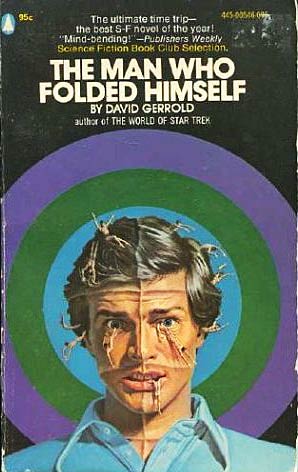
David Gerrold - The Man Who Folded Himself (1972)

"I went back and talked myself out of eliminating Jesus Christ."

Not as cool as the original cover.
   Since H. G. Wells' 'The Time Machine', time travel has been an essential part of SF, but it's rarely thought through to any great extent, not even by TV shows that have time travel as part of the central conceit. Frequently little more than lip service is given to the mechanics of the process, the paradoxes that can result from it or the practical applications that it provides to those using it. I like to point to 'Bill And Ted's Excellent Adventure' as a good example of time travel used well, as not only is the time travel in that film internally consistent, the heroes, for all their apparent idiocy, realise that because they can travel through time, there's no reason why they shouldn't make life easier for themselves by coming back later and leaving useful items in convenient places. Leaving aside the blatant missed opportunities, Michael Bishop points out in 'No Enemy But Time' that the problem with travelling back in time, say, to the Pleistocene era to make out with some hot Homo habilis, (read the book, this is exactly what happens), is not just the temporal difference - the Earth, Solar System and Milky Way itself have been moving for all those millions of years, winding up in a completely different relative position. 'The Man Who Folded Himself' by David Gerrold is one of the fullest, most complete explorations of time travel and its implications the genre has ever produced.
   In 'The Man Who Folded Himself', Daniel Eakins is left a belt and a document by his recently departed Uncle Jim. The document purports to be from an alternate version of himself, who received this belt in turn when his Uncle Jim died. The belt is a timebelt which allows him to travel to any set point in the past or future. Daniel proceeds to use this new found ability to cheat at the horse races to make money, see great historical events, and interact with past and future versions of himself, including having sex with both male and female versions of himself. In short, all the things you would probably do if you discovered you could travel through time.
Would that this belt were a timebelt!
   The time travel in 'The Man Who Folded Himself' is thought out to the last detail. Daniel sensibly does some experiments to determine how it works, to find out if he can change the past or not. He likens time travel to painting, and changing the past to going back and painting over a previous mistake - the artist knows the original mistake is there but just covered up, but no one else does. Ultimately he realises that each time he travels through time he is jumping to an alternate universe. This allows him to change events in this universe without affecting his origin in a different universe - he can go back in time and kill his great grandfather, but his great grandfather still existed in the universe that spawned him. It also provides a sensible rational for why someone would invent such a potentially dangerous device - all the malcontents who would wish to rewrite time to their advantage can cheerfully go and do so in some alternate universe, preserving the original. Daniel can always go back in time and stop himself from making some change by appearing to his past self before he makes the change and talking himself out of it. This transports both versions into new variant universes, and so means he can make changes like this without the fear of erasing this variant of himself from history.
   David Gerrold is probably most well known to SF fandom for writing one of the most iconic episodes of the original Star Trek, 'The Trouble With Tribbles'. After reading 'The Man Who Folded Himself', I think the most quintessentially Gerrold-ish part of the episode is where, after the fight breaks out between the crew of the Enterprise and the Klingons on Space Station K-7, Kirk interrogates his crew to find out what happened. What could be unspeakably tedious as we hear described exactly what we just witnessed instead becomes a deft piece of comedy as Kirk ekes out the truth from Scotty that the fight broke out not because the Klingons insulted Kirk but because they insulted his precious Enterprise. Gerrold here gets similar comic mileage through describing events from different perspectives, as Daniel interacts with his past and future selves, but at the same time he uses it to make serious points about the nature of perspective and the difficulty of communication between people. Even between different versions of himself, there is a gap between the intention and how it is received, as he finds different versions of himself naive or cocky.
   As well as being about time travel, 'The Man Who Folded Himself' is about individual people and what it means to be one. Daniel welcomes the opportunity to interact with another version of himself because he finds the strains of interacting with other people exhausting. I think we can all relate to this on some level. When he is with another version of himself, Daniel no longer has to worry about impressing the other person whether or not they like him, if what he says or does will be misinterpreted. However as the different versions of Daniel diverge and undergo different experiences, even though they started out as the same person they become different people. In effect, it's the things we experience and the things we do that make us who we are. Change this and you change the person. In this way, 'The Man Who Folded Himself' is a tribute to the almost infinite potential within each person.
   The book also explores just how complicated human sexuality is. 'The Man Who Folded Himself' was notable for its frank depiction of both homosexual and heterosexual sex, something the genre still to this day is not exactly well known for. It is not accurate to define Daniel as either purely straight or purely gay. As the different time-variants of Daniel branch out, some of them find happiness in relationships with other Daniels while some of them are ashamed by their attraction to other versions of themselves. The version of Daniel we follow through the main narrative finds sexual satisfaction both with the male Daniels and with a female time variant of himself, with whom he has a child.
   This child ultimately grows up to become Daniel, while Daniel himself becomes his own Uncle Jim, leaving the timebelt to himself as his own inheritance. Thus the circle is completed, Daniel's life is like the worm Ouroboros eating its own tale, with no beginning and no end.
 

Wednesday, 28 August 2013

Michael Moorcock – The Cornelius Chronicles (1969-1977)

“Jerry didn't mind the bombs as much as the rock scene. He wouldn't care what they sent so long as it wasn't Simon and Garfunkel.”

   
Jerry Cornelius is quite possibly the weirdest incarnation of Michael Moorcock's Eternal Champion. Jerry is an achingly cool secret agent assassin pansexual music snob who dies and comes back to life frequently. He's armed with supercool weapons like the needlegun and the vibragun, and he throws parties so cool that everyone from Elric to Charlie Parker to Hawkwind attends, (though no one leaves). While all incarnations of the Eternal Champion strive to restore the balance between the forces of order and chaos, Jerry is purely a force of chaos who is never happier than when tearing down empires, regimes and civilisations, or just generally running amok. All this is weird enough, but it doesn't cover the way in which the stories are told. Moorcock wrote the original four Cornelius novels at the height of the 60s counterculture and SF's bold and experimental New Wave, leading him to write a series firmly engaged with its turbulent time and enlivened by the avant-garde techniques of William Burroughs. Aside from the first book in the quartet, the Cornelius stories are told out of chronological order and interspersed with cut-up text from headlines, adverts and newspaper articles to emulate a true sense of chaos. But for all that, Moorcock's pulp instincts and his feel for a good story hold the whole thing together, creating one of those rare pieces of art that manages to be both boldly experimental and immediately engaging. Indeed, these four books may be the great man's crowning achievement.

The Final Programme (1969)

Amazingly, the actual book is arguably weirder than the cover. 

   'The Final Programme', the first Cornelius novel, is relatively straightforward. 'Relatively' being the operative word. When we are first introduced to Jerry Cornelius, he is scheming with a bunch of dubious characters to storm his father's house by sea where his brother, Frank, has holed up so he can steal back his sister and lover, Catherine, from him. This should appear familiar to fans of Moorcock's work, as it's basically the same plot as the first Elric novel. But it is far from simply being a retread. Whereas Elric has always been about moral ambiguity - Elric realises that a lot of the stuff he does simply isn't very pleasant, and boy does he angst about it - Jerry Cornelius is gleefully amoral. Even when he accidentally shoots and kills Catherine, as Elric does to his sister in 'The Dreaming City', he seems more sulky because he's lost this particular game rather than devastated by the death of his true love. 

Jerry, seen here Corneliusing
   Jerry's associates are lead by Mrs. Brunner, the ying to Jerry's yang, a Thatcher expy who represents order at its most fascistic and stiffing. She is hoping to use the technology designed by Cornelius' father to create a computer capable of running the ultimate programme that would be able to predict the fate of the earth and everyone in it to the smallest detail. On the promise of revenge, Jerry tags along with Miss Brunner to track down Frank through secret Nazi caves in Lapland to find a secret document left by Major Newman, an astronaut who allegedly gained some profound insight on a mission that went wrong. This of course Moorcock fans will recognise as a retelling of the Elric story 'While The Gods Laugh'. 

Pictured: cosmic illumination
   Like Elric and his sword Stormbringer, Jerry and Miss Brunner are suggested to be two halves of one whole. In much the same way as Elric draws energy from Stormbringer eating souls, Jerry is a kind of energy vampire who feeds off the life energy of those around him. But Jerry shows himself to be a very different kind of (anti-)hero to Elric. For much of the book he just coasts along; even the promise of revenge against Frank hardly seems to get his blood flowing, and he barely tries to stop Miss Brunner from completing her evil plan. In addition, unlike Elric, Jerry Cornelius likes sex. A lot. In addition to his incestuous relationship with Catherine, Jerry will and does sleep with anything that moves, male or female, allowing himself to be seduced as much as seducing. 
   In the end, Miss Brunner runs her final programme and has sex with Jerry, and the merge into the hermaphroditic being Cornelius Brunner, forming a kind of dark messiah that brings about the apocalypse by leading the whole of the human race into the sea to drown. Perhaps as chaos and order have been united in the perfect balance, there is nothing left for this universe. (This is the first book in a series).

The triumph of Cornelius Brunner
 A Cure For Cancer (1971)

"This book... has an unconventional structure."


   Jerry Cornelius returns in 'A Cure For Cancer', apparently none the worse for wear for merging with Miss Brunner and causing the apocalypse. Perhaps more than any other incarnation of the Eternal Champion, the Cornelius stories make full use of the concept of the multiverse - different alternate universes in which the same struggle between order and chaos is endlessly recapitulated. 'A Cure For Cancer' warns us at the beginning that it has an unconventional structure. While 'The Final Programme' is a linear story that, while weird, still holds together and makes narrative sense, the rest of the Cornelius Quartet from here on out is told out of chronological order, in a series of disjointed but related scenarios playing out in different times and in different universes, as characters representing larger concepts interact. We already have Jerry representing chaos and Miss Brunner and Frank representing the extremes of order, but 'Cancer' expands the Cornelius troop to include the greedy and lustful Bishop Beesley, who represents organised religion. 

Pictured: subtlety
   This time round, Jerry manifests as a photo negative version of himself from the previous novel - white hair and ink black skin and teeth. This Jerry is hardly a moral inversion of the old Jerry - he's just as amoral here as he ever was. This time he's searching for a device he invented that allow him to switch between universes - at the cost of absorbing life in this universe - in order to find a universe in which his beloved Catherine is still alive. 


   As well as facing off against Bishop Beesley, who wants to steal Jerry's device to create a universe of such pure order that time itself will stop, Jerry has to contend with the deranged military forces that Frank has allied himself to this time, militaristic psychopaths who have turned England into a battleground in order to wipe out what they see as some kind of ideological cancer. 'A Cure For Cancer' was written during the Vietnam war, but it's not hard to see how its satire remains pertinent today. 
   While the disjointed structure makes it difficult to figure out exactly what's going on, that's kind of the point. Here Moorcock is plunging us directly into the chaos, and his disruption of conventional narrative structure comes off as a masterstroke. The characters are well drawn enough and there is a consistent texture of atmosphere that the novel maintains its own momentum and is able to come together somewhat for its conclusion. While Jerry may be amoral, selfish and dangerous, he's a darn slight better than the forces he's up against. 

The English Assassin: A Romance Of Entropy (1972)

"As he had often suspected, the end had come quietly and the breakdown had been by slow degrees. In fact the breakdown was still going on. Superficially there was nothing urgent about it. As the weeks passed and communications and services slowly worsened, there always seemed to be a chance that things might improve. He knew they could not improve."

Ashes to ashes...
   Jerry Cornelius himself sits this one out for the most part, which is understandable as the guy's in something of a bad way, drudged up from the ocean floor or screaming incoherently. But that's OK because it gives us more time to focus on the supporting cast. Una Pearson, the suave female assassin who first appeared in the Oswald Bastable novels but is much more at home in the Cornelius crew, takes centre stage here, acting as much as an agent of chaos as Jerry ever did, shooting up European aristocracy and taking his place as Catherine's lover as well. Catherine herself finally gets to spend some significant time alive and undergoes some character development herself. We are introduced to Prinz Lobkowitz, who represents the fading European aristocracy (and gets killed by Una a lot), Major Nye, who represents British Imperialism, Jerry's larger than life cockney mum and her lover, the lugubrious Colonel Pyat. 
   'The English Assassin' follows the unconventional structure of 'A Cure For Cancer' but takes it even further. While in 'Cancer' there was more or less a single narrative thread that it was just about possible to untangle, 'Assassin' atomises the narrative further, providing a series of vignettes occurring across multiple universes and time streams as the characters struggle for the upper hand in this particular iteration. Whilst not providing a solid narrative drive, each of these scenarios deepens our understanding of these characters and the way they interact. Although they all have different agendas, over the course of the novel we see just about every possible permutation of characters working together to further their own needs, proving that they are not as different as perhaps they would like to believe. The openness of the symbols recurring throughout the Cornelius stories and the vagueness of the actual plot allow a myriad of interpretations, which again is perhaps part of the point. 

The Condition Of Muzak (1977)

"Soon he was nearing London. In the evening light the city was phosphorescent, like a neon wound; it glowed beneath a great scarlet sun turning the clouds orange and purple. And Jerry was filled with a sudden deep love for his noble birth-place, the City of the Apocalypse, this Earthly Paradise, the oldest and greatest city of its Age, virgin and whore, mother, sister, mistress, sustainer of life, creator of nightmare, destroyer of dreams, harbour of twenty million chosen souls."

"All art constantly aspires towards the condition of muzak."


   How do you bring to an end something as open-ended and bizarre as the Cornelius Chronicles? 'The Condition Of Muzak' manages the nigh-impossible by acting as both a summation, a clarification and an obfuscation of everything that's gone before. The narrative is as jumbled and as piecemeal as in 'The English Assassin', but here the pieces of story we get appear to be from in between and behind the scenes of all that has gone before. Or is it? Are we catching Jerry in between the missing gaps in 'A Cure For Cancer', are we going to get enough context to be able to put all the events in 'Assassin' into a coherent order? Moorcock is aiming for nothing so simple. These could be the missing pieces of story, or they could be part of some other similar iteration in a different universe, or it could be Jerry sighing and going through the motions of repeating everything from the previous books for our own benefit. Or perhaps, as some sections of 'Muzak' indicate, Jerry is just some seedy kid from Ladbroke Grove who dreams of being a multiverse-surfing super spy because he and his beloved spacerock group The Deep Fix just can't catch a break. The Appendices at the back of the book thumb their nose to the very idea of continuity, giving a timeline of events across the whole of the Twentieth Century and the whole of the world which one man could not possibly have taken part in.
   The interactions between the characters this time round give us some of the clearest examples of who they really are. For example, Miss Brunner explains to Jerry, "Liberty! How I hate it! Given the chance I intend to establish a sane element of authority in this country again." 'Muzak' also puts Moorcock's vision of the future into clearer focus. A recurring element of the endgame scenarios dreamed up in the Cornelius Chronicles is the Balkanisation of larger states, and this is shown clearly here, with England splitting up into a multitude of tiny city states. 
   Also in focus is is Jerry himself and his role in the narrative. The novel's title refers to something that was once shocking and invigorating becoming mere background noise, a condition both Jerry and the Twentieth Century find themselves in at the beginning of the story. The sixties have given way to the seventies, the hippy dream has died and as a new age of cynicism is ushered in Jerry finds himself disillusioned with all his musical heroes, and perhaps with the very idea of heroism to begin with. If you deal in it all the time, even chaos can become boring. Jerry's ensuing identity crisis is played out with reference to the comedia dell'arte, with Jerry (and the audience) assuming that he has the role of Harlequin, with Catherine as his Columbine, and this drives his attempts to find a universe in which he can be with her. However, as the story continues, he begins to realise that his true role is that of Pierrot, the sad clown, and that he is always destined to lose his Columbine, and that Una Pearson is her Harlequin. While this suggests that Jerry will never be able to be with Catherine, it provides Jerry with a way out by taking the narrative pressure off him. Jerry ends his chronicle with the chance to shrug off the chains of narrative conceit, to stop being merely a symbol of chaos and perhaps to live a while as just a person. 

Tuesday, 27 August 2013

George R. R. Martin - A Song Of Ice And Fire Book Two: A Clash Of Kings (1998)

"What good was it to take a kingdom if you could not hold it?" Theon Greyjoy

"You should have learned by now, none of us get the things we want." Cersei Lannister


   At the end of book one, the Seven Kingdoms teetered on the edge of chaos as five kings laid claim to the Iron Throne. 'A Clash Of Kings' picks up pretty much directly where 'A Game Of Thrones' left off, but as well as focusing on all the pieces already in motion, George R. R. Martin continues to expand the world of Westeros, adding more characters and more viewpoints. So while Tyrion Lannister becomes the King's Hand and sets about trying to fortify King's Landing and minimise the havoc caused by King Joffrey, Robb Stark cements his position as King of the North by leading more battles against the Lannisters and Arya tries to escape to the North with Yoren and the Night's Watch, the late Robert Baratheon's brothers Stannis and Renly gather their forces to make their claim to the throne. If that sounds like it would make for a narrative even more packed and complex than that of 'A Game Of Thrones', well, it does. Astonishingly Martin just about manages to keep all the juggling balls still in the air, though perhaps inevitably the strain does show at times. For all that, it's a thoroughly satisfying sequel, and the action-packed siege of King's Landing is even more exciting than anything in the first book. 

Another book, another map
      As Theon neatly points out at the top of the page, one of the main themes of the book is that being able to achieve power doesn't necessarily mean you are fit to rule. Robert Baratheon became king because he was a great warrior, the one who defeated Rhaegar Targaryen at the Trident. However the very characteristics that made him a great warrior made him a lousy king. Renly shares Robert's easy charisma, but is similarly blase about the practicalities of running a kingdom. Stannis, with his strong sense of justice and serious mind, is much better suited to rule, but his lack of charisma means he is unable to get the popular support necessary to support his claim. In his desperation he winds up allying himself with Lady Melisandra of Asshai, a member of a creepy cult built around the creepy Lord of Light and possessed of sinister dark powers. We see Stannis mainly through the eyes of Davos, a former smuggler knighted by Stannis for single-handedly allowing Stannis to last through the siege of Storm's End. At the same time Stannis also cut off Davos' fingers to punish him for smuggling, which tells you all you need to know about Stannis' sense of justice. Davos is staunchly supportive of Stannis, and his story arc, where he sees the man he respects and loves making worse and worse decisions and heading further and further into the abyss, are grim and powerful.
   Arya Stark also finds herself allying with dubious powers. Yoren's attempt to save her and one of King Robert's bastards by smuggling them north with the new recruits for the Night's Watch is quickly and brutally punished in the way only Martin does. In the ensuing chaos, Arya assists dangerous Lothari madman Jaqen H'ghar, and so when Arya is captured by Gregor Clegane and forced to work as a servant at Harrenhal, he pays her back by offering to kill three people of her choice. She uses this new power to free the Lannister's Northern prisoners and help them take over the castle, but it is a tribute to Martin's gritty cynicism that the servants and workers are no better under the Northern bannermen's control than under the Lannisters. 
   While Arya and Stannis struggle with morality and fight to retain their souls, Theon Greyjoy cheerfully jumps right past the moral event horizon. Nothing more than a minor annoyance in the first book, in 'A Clash Of Kings' Theon becomes a viewpoint character and we get to find out what a toxic environment the inside of his head is. Much like Joffrey, he is revealed to be a twat before his villainy is revealed. Writing for Theon must be a delicate balancing act - he gets enough of a sympathetic backstory that we know exactly where he's coming from and why he is the way he is, whilst his actions always keep us from feeling any actual sympathy towards the character. The Greyjoys as a whole are just awful - parasites who smugly announce 'We Do Not Sow' because they get everything they need by thievery. Desperate to prove his worth, Theon betrays the Starks and takes over Winterfell. His absolute lowest moment comes when he tries to kill Bran and Rickon, and failing to do that murders two similarly aged children to prove he will not be screwed with. As the quote at the top of the page shows, he has moments where he is quite savvy, but because he's an idiot he makes a series of spectacularly poor decisions and gets his thoroughly earned comeuppance. 

The Greyjoy words are "We're going to try our darndest to be worse than the Lannisters! Wish us luck!"
   If the main storyline of 'A Game Of Thrones' was Ned Stark investigating the circumstances surrounding John Arryn's death, the main plot in 'A Clash Of Kings' follows Tyrion's attempts to rule in Joffrey's stead. Tyrion is probably the only character in the book with both the moral fibre to rule justly and the cunning to survive in the cutthroat environment of the King's court. Much of the book involves Tyrion, Varys and Littlefinger snarking at and manipulating each other. It's thoroughly entertaining, and I would happily watch a TV show that was only that. Tyrion has enough awareness that in order to survive and keep the peace in an increasingly fractious environment he is going to have to do some fairly unpleasant things. At one point in the book he comforts himself with the thought that "It is not what we do, so much as why we do it." Really he should know better. Like Ned Stark he is surprised when he discovers that his idealism has alienated people; in fact he winds up the most hated Lannister. Some of this is discrimination, and some of it is that people don't realise the work he does to undermine all the damage Joffrey does, but some of it - that he's filled the city with murderous sellswords - is actually fair enough. For all his careful planning, in the siege of King's Landing at the end Tyrion leads the battle, which winds up getting him grievously injured.    
   'A Clash Of Kings' is also a great book for Sansa and Catelyn. Sansa continues to grow and develop as a character, showing remarkable fortitude in the face of adversity, for what good it does her. At least by the end of the book she is no longer betrothed to Joffrey, though how much good this does her in the long run is debatable. She also acts as the audience's viewpoint on Cersei Lannister for much of the book. Cersei herself gets a fair bit of character development as well, even having a couple of humanising moments as well as neatly summing up how Martin's universe works. Jaime only appears for one scene, but it's a good one, as he baits Catelyn in his cell at Riverrun. Catelyn continues to exemplify the Tully family motto: 'Family. Duty. Honor." Whilst dealing with her grief, she frequently winds up being the only sane man in a world with more than its fair share of hotheads and idiots. Martin's cheap trick of making her believe that Bran and Rickon are dead really stings; the poor woman has enough on her plate already. Meanwhile the threat beyond the Wall grows ever greater as Mance Rayder gathers the forces of the wildlings together for a massive assault; Jon Snow winds up having to seemingly betray his oath as a brother of the Night Watch and joins the wildlings in order to become a double agent.
   The only major character I've not mentioned so far is Daenerys. There's a reason for that. While Martin finds plenty to keep her busy with over the course of the book - she leads her Dothraki raiders through a desert, meets a warlock and has a dream quest - her story is noticeably separate from everyone else's. While all the other characters' actions have impacts on the other characters' stories, creating a complex, interweaving narrative, nothing Daenerys has done so far has had an impact on this, nor has any of it effected her. Hopefully that will change in the next book, as at the end Illyrio Mopatis makes himself known again and provides her with the means to get her forces to Westeros. Hopefully next time round she will have more interaction with the main plot.
  Oh, and yes, Tyrion does get to slap Joffrey again. I really hope this happens in every book.